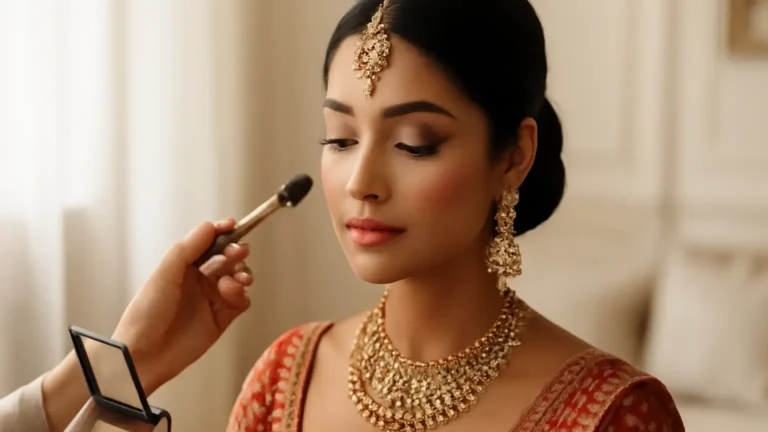
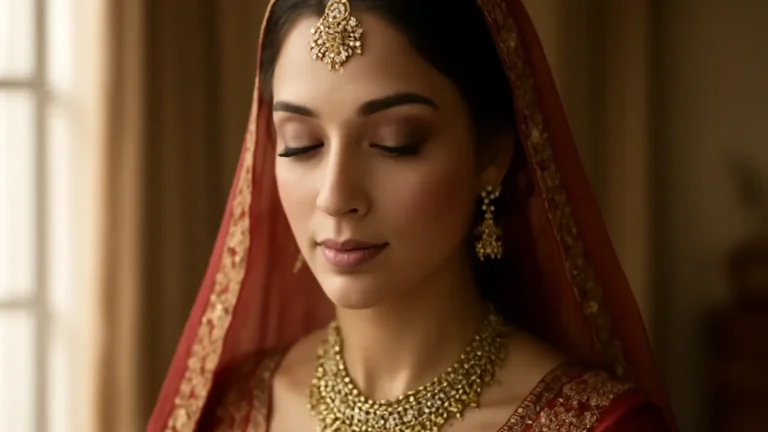
Bridal makeup for combination skin works best when shine and dryness are managed separately, not covered with one heavy, matte layer. This guide is for Indian brides whose forehead and nose become oily while the cheeks feel normal, dry or textured. You’ll learn how to adjust prep for your region, place two types of primer strategically, build a breathable bridal base and carry out discreet touch-ups that keep the face polished rather than flat.
Start with the skin map, not a one-finish rule
Combination skin usually has more than one makeup need at the same time. The forehead, nose and chin may develop shine, while the cheeks remain comfortable, dehydrated or slightly flaky. Bridal makeup should respond to those zones individually. Trying to make the entire face matte can emphasise texture and make the complexion look less fresh in photographs.
Before your trial, observe your skin for a few hours after cleansing. Note where shine appears first, where foundation separates, and whether the cheeks feel tight after powder. Also consider your ceremony setting. A summer outdoor pheras ceremony in Delhi, a humid coastal wedding in Mumbai or Kochi, and a dry winter celebration in Jaipur will each call for a different balance of hydration, powder and touch-up timing.
- Oily or shiny zones: usually the nose, inner cheeks, forehead and chin. These need thin layers, controlled prep and targeted setting.
- Normal or dry zones: often the outer cheeks and around the mouth. These need comfortable hydration and minimal powder.
- Textured zones: areas with visible pores, dryness or uneven surface. These look better with gentle smoothing and flexible layers than with thick coverage.
Take reference photographs in daylight and under the venue’s likely lighting during your makeup trial. Flash can reveal excess powder, while warm indoor lighting can make a base look more yellow than it is.
Build a regional bridal skin preparation plan
A reliable combination skin skincare routine before the wedding should be simple and familiar. On the morning of the event, cleanse without scrubbing, apply a lightweight moisturiser and allow each layer to settle. Use more moisturiser on the cheeks if needed and less on the nose and forehead. Your makeup artist can then adjust the professional prep without having to correct an overloaded skincare layer.
For humid weather makeup, keep the daytime routine light and avoid adding several rich products in the hope that they will prevent dryness. Humidity can increase surface shine, but air-conditioning may still make the cheeks feel dry. A gel-cream moisturiser on the T-zone and a slightly more cushioning layer on the cheeks can be more useful than one heavy cream everywhere.
In a dry climate, do not skip hydration simply because you are concerned about oil. Flaky skin makeup tends to cling around the nose and mouth when the skin is under-moisturised. Apply moisturiser to those areas, wait for it to absorb, then gently press away any excess with a clean tissue before base makeup.
Avoid introducing a new exfoliant, peel, facial, active serum or home remedy immediately before the wedding. New products can cause irritation or unexpected texture. Keep the final week focused on products your skin already tolerates. If persistent redness, itching, painful breakouts or unusual irritation concerns you, seek advice from a dermatologist rather than trying to conceal or treat it with extra makeup.
Use primer by location and purpose
The best primer for combination skin bridal makeup is not necessarily one product applied in the same amount across the face. Primer should solve a specific problem and remain compatible with the foundation chosen for the rest of the base.
For the T-zone
Use a thin mattifying primer on the sides of the nose, centre of the forehead and chin if these areas become visibly oily. Press it in rather than rubbing over the skin. Keep the layer local; extending a very mattifying formula onto the cheeks can make the face look dry and increase the appearance of texture.
For the cheeks
A hydrating primer can add comfort and help a base spread more evenly on normal or dry cheeks. Choose a light formula if your foundation is already luminous. The goal is a smooth, flexible surface, not a slippery layer that causes the base to move.
For visible pores or uneven texture
Use a smoothing primer only where it is needed, usually around the nose and inner cheeks. Press a small amount into the area and give it time to set. More primer does not automatically create a smoother finish; excess product can pill or make foundation separate.
At the trial, test primer and foundation together. A water-heavy primer under a formula that does not sit well with it may ball up, while a very silicone-rich combination may feel smooth initially but wear unevenly. The practical test is how the base looks after several hours, not how perfect it appears immediately after application.
Layer the bridal base for combination skin
A bridal base for combination skin should be built in thin, controlled layers. Start with colour correction only where discolouration needs it. A small amount of corrector beneath the eyes or around the mouth is usually preferable to adding a thick layer of foundation across the whole face.
- Apply base in sections. Begin at the centre of the face, where coverage is often most useful, and blend outward. This leaves less product on the cheeks and hairline.
- Use a suitable finish. A natural or soft-matte long-lasting foundation can balance shine without removing all dimension. If the formula is very matte, use less on dry zones.
- Press, do not repeatedly buff. A damp makeup sponge or a well-controlled brush can press product into the skin. Repeated rubbing may disturb skincare and highlight flaky patches.
- Add concealer selectively. Place it only where extra coverage is needed, then blend the edges into the foundation. Avoid creating thick, bright blocks below the eyes.
- Check the jaw and neck. Match the foundation to the face and confirm it works with the neck and the colours worn for the ceremony. Assess the shade in natural light.
For a dewy bridal makeup result, keep glow in intentional areas such as the upper cheekbones rather than allowing shine to appear across the nose and forehead. Cream blush can look natural, but lightly set the areas where cream products tend to move. Powder blush or a very light veil of powder can be layered over it for improved staying power.
Control powder without flattening the complexion
Setting powder is a placement tool, not a compulsory full-face mask. Use a small fluffy brush or puff to press powder into the T-zone, around the nostrils, beneath the lower lip and wherever the base tends to crease. Leave the outer cheeks lightly set or unpowdered if they are comfortable and smooth.
Translucent powder is convenient, but the formula still matters. A heavy application may look dry in person and pale or textured under flash photography. Press off excess powder from the puff before touching the skin. If you prefer a tinted powder, check that it does not alter the foundation colour as it builds during touch-ups.
For oil control makeup, blot first and powder second. Powdering directly over a layer of oil can create a thick, patchy surface. Use blotting paper or a single-ply tissue, press gently, and then apply a small amount of powder only to the recovered area. Never drag the paper across the face.
Ask for a final check under daylight, venue lighting and flash if possible. A base that looks beautifully matte from close range may appear flat from a distance. Keep some natural dimension on the cheeks so jewellery, fabric and facial features do not compete with a blank-looking complexion.
Plan touch-ups around the wedding schedule
A useful makeup touch-up kit should contain blotting sheets, a small amount of the setting powder used by the artist, a clean compact mirror, cotton buds, lipstick, lip liner and a small sponge or puff. If you wear a bindi, veil or heavy jewellery, include any safe accessory replacements you may need. Do not carry several unfamiliar complexion products and layer them during a busy event.
Touch up before the photographs rather than waiting until shine is obvious. A simple sequence is:
- Move to a clean, well-lit spot and gently blot the nose, forehead and chin.
- Check whether the base has actually separated. If it has not, do not add foundation automatically.
- Press a tiny amount of powder only on the shiny area.
- Use a clean cotton bud to lift mascara or foundation that has collected in a crease.
- Refresh the lips and inspect the cheeks for accidental product transfer from a dupatta or veil.
If a patch has broken down, avoid covering wet or oily product with more powder. Blot, soften the edge with a clean sponge and ask the makeup artist or a trusted helper for a small amount of matching foundation. This is more controlled than repeatedly rubbing at the area.
Common mistakes that make combination skin look less balanced
- Using matte products everywhere: this can make cheek texture and fine dryness more visible.
- Applying too much moisturiser under the T-zone: a heavy layer may shorten wear time without solving dehydration.
- Skipping moisturiser because of shine: under-prepped cheeks can make the base cling and crack.
- Choosing a foundation only by its first-hour finish: assess it after movement, heat, photographs and several hours of wear.
- Powdering before blotting: this often creates a thicker, uneven surface.
- Trying a new product just before the ceremony: even a popular formula may not suit your skin or existing routine.
Your artist should also know the event sequence: haldi, pheras, reception, outdoor portraits and indoor dancing all place different demands on wear. A base designed for a short indoor ceremony may need a different setting strategy for a long humid-weather schedule.
Choose the finish by priority
| Priority | Useful approach | What to avoid |
|---|---|---|
| Maximum wear on a humid day | Light prep, local mattifying primer, thin natural-matte base and targeted powder | Heavy cream layers and full-face powder |
| Comfort on dry cheeks | Hydrate cheeks, use flexible foundation and keep powder on the centre of the face | Strong matte primer across the cheeks |
| Photographic dimension | Softly set the T-zone and retain controlled satin light on the cheekbones | Uncontrolled shine or thick pale powder |
| High coverage | Correct selectively and build foundation only where necessary | One thick layer over the entire face |
Concise takeaway
The most reliable bridal makeup for combination skin separates the problem zones: hydrate where the face feels dry, mattify only where oil appears, and build coverage gradually. Test the full routine in the regional climate and under likely lighting, then touch up by blotting before powdering. The result should look polished, dimensional and comfortable rather than uniformly flat.
Products that may help with this routine
Choose only what fits your skin, hair or personal needs. Use the links below to view current options on Amazon India.
Frequently Asked Questions
How do you prep combination skin before bridal makeup?
Cleanse gently, use a familiar moisturiser, add more hydration to dry cheeks and keep the T-zone lighter. Let skincare settle, then use primer by zone. Avoid new exfoliants, facials or active products immediately before the wedding.
What is the best primer for combination skin bridal makeup?
The best approach is often two targeted primers: a light mattifying primer on oily areas such as the nose and forehead, and a hydrating primer on dry or normal cheeks. Test both with the planned foundation during a trial.
How do you stop bridal makeup from getting oily in the T-zone?
Use light skincare, apply a small amount of mattifying primer to the T-zone, build a thin foundation layer and press powder only where needed. During touch-ups, blot oil first and then add a little powder.
How should you apply foundation on combination skin for a wedding?
Apply foundation from the centre of the face outward in thin layers. Use less product on the cheeks, press rather than over-buff, and add concealer only to areas needing extra coverage. Check the shade in natural light.
What powder is best for combination skin bridal makeup?
A finely milled translucent or suitably tinted setting powder can work, provided it is applied lightly and only to areas that crease or become shiny. The formula should be tested under the wedding venue’s lighting and flash.
How do you touch up combination skin bridal makeup?
Blot the T-zone gently, inspect for actual separation, then press a small amount of the original setting powder onto the area. Avoid repeatedly layering powder over oil or rubbing a broken-down patch.