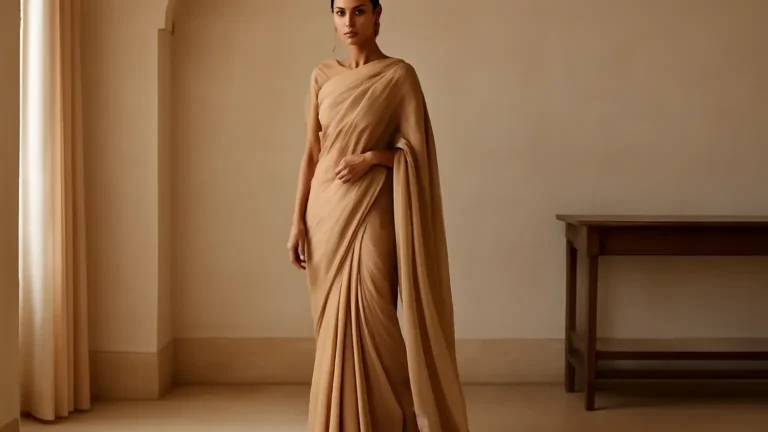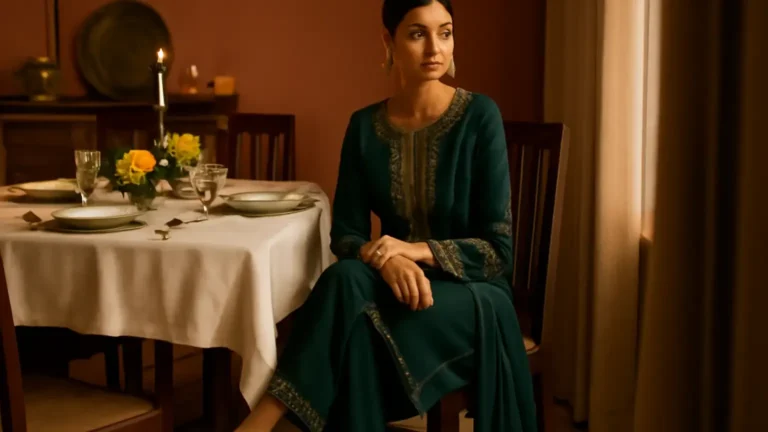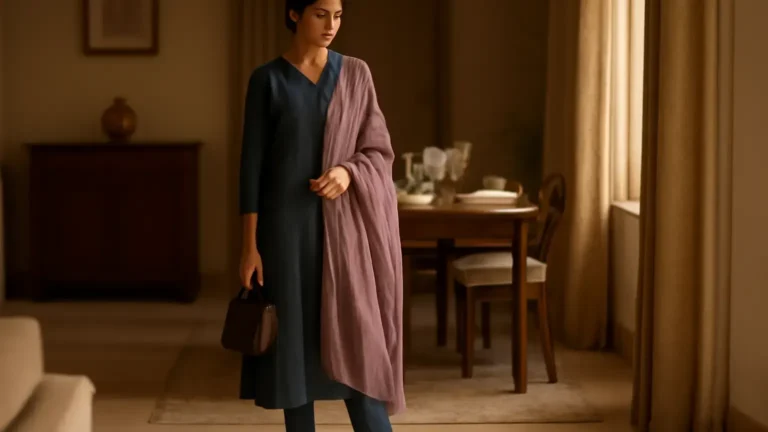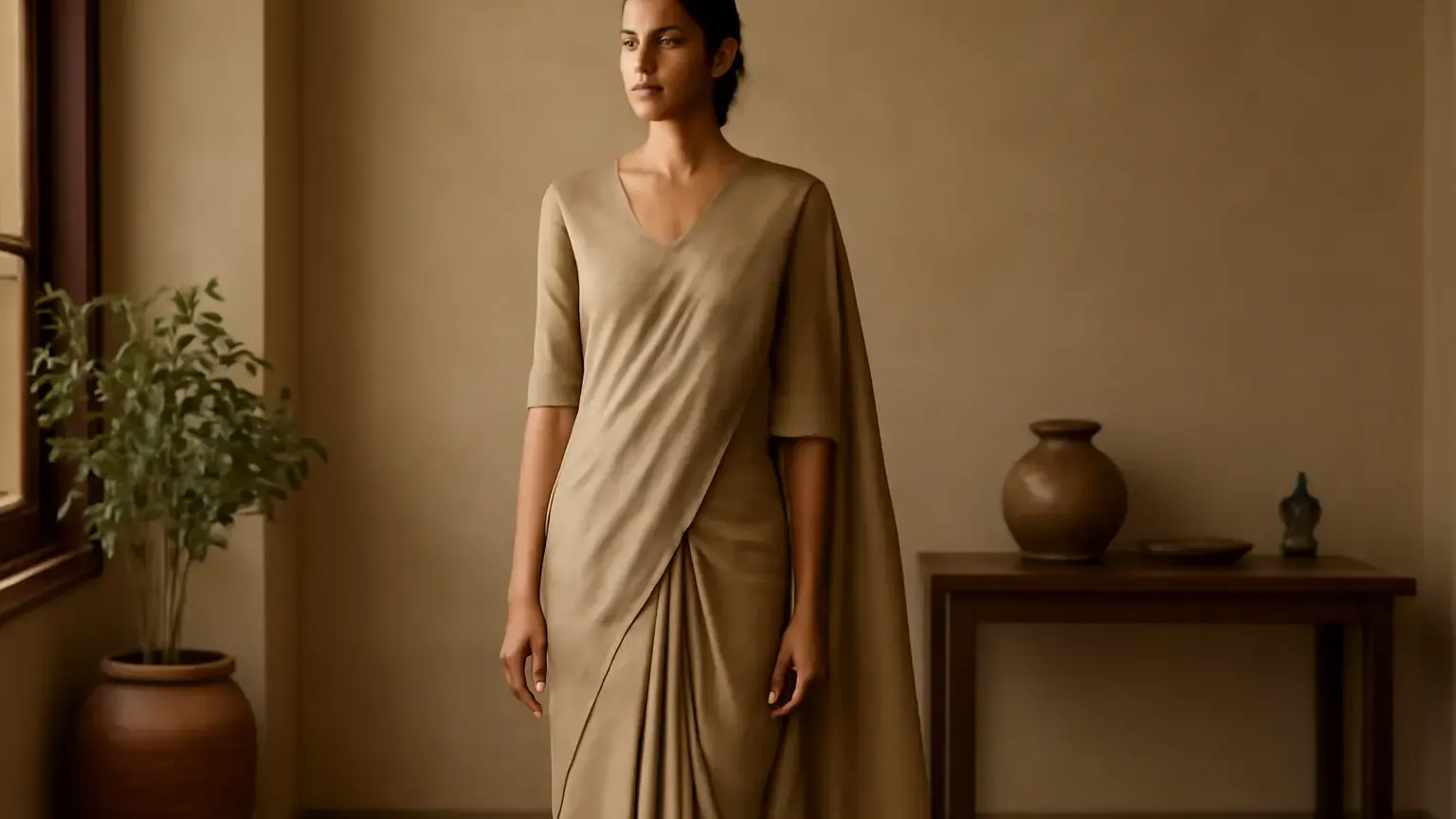
Saree styling for broad shoulders works best when the eye is guided vertically rather than widened across the upper body. This guide is for anyone who wants a more balanced saree silhouette, whether your shoulders are naturally broad, your blouse has strong structure, or you simply prefer less emphasis at the top. Start with a softly placed pallu, moderate front pleats, a gently open neckline and long, uninterrupted accessories; then adjust fabric and fit to your frame.
A broad-shouldered frame does not need to be disguised. The aim is proportion: distribute visual attention between the shoulders, waist, pleats and pallu so the saree falls in one calm, continuous line. The most reliable formula combines a blouse that follows the body without adding bulk, a pallu that does not sit stiffly across the shoulder, and front pleats that are neat rather than oversized.
Build a balanced saree silhouette first
Before choosing a print or jewellery, look at the complete outline in a mirror. If the upper body appears much wider than the lower half, add length and movement through the centre of the outfit. If your shoulders are broad but your hips are also prominent, you can use a more even approach and focus on clean finishing rather than reducing volume anywhere.
A balanced saree silhouette usually has three features:
- A clear vertical centre: the blouse opening, pleat line and pallu fall should help the eye travel up and down.
- Controlled horizontal details: avoid placing heavy borders, contrast bands or stiff folds directly across the shoulder line.
- Proportionate volume: the pallu and pleats should have enough body to drape well, but not so much width that they compete with each other.
For everyday sarees, lightweight saree fabrics such as crepe, georgette, soft cotton-silk or fluid satin blends can be easier to arrange than very rigid textiles. This is not a rule against silk or handloom sarees; it simply means that a firm fabric may need more deliberate pleat width and pinning.
Choose pallu placement that adds length
Pallu placement for broad shoulders is often more important than the saree colour. A narrow, softly spread pallu that begins near the shoulder and falls close to the body creates a vertical panel. A very wide, stiff pallu spread from arm to arm creates a horizontal line and can make the upper frame look broader.
Open pallu versus pinned pallu
An open pallu can be flattering when it falls straight and remains relatively narrow. Let it skim the side of the torso rather than fan out over the chest. Keep the top edge relaxed, and avoid excessive pleating at the shoulder if the fabric already has a bold border.
A pinned pallu is useful for work, travel and occasions where you want a precise shape. Pin it slightly behind the shoulder’s highest point instead of placing all the fabric on top of the shoulder. This shifts the visible line inward and leaves the front of the blouse less crowded.
When wearing a contrast border, allow only a modest section to show across the upper body. A border that drops vertically along the pallu can support the same lengthening effect. If the pallu keeps sliding, use discreet pins at the shoulder and near the waist rather than making the shoulder fold thicker.
Select a blouse neckline for broad shoulders
The best blouse neckline for broad shoulders is usually one that creates an open centre without adding width at the outer edge. Soft V-necks, U-necks and moderately deep sweetheart necklines can lengthen the visual line of the chest. A narrow keyhole may also work if it does not introduce a wide horizontal bar.
Neckline depth should suit comfort, occasion and the blouse’s support. The neckline does not need to be very low to be effective. Even a gentle V or a clean U can create separation between the neck and shoulder area.
- Good starting choices: soft V, elongated U, sweetheart and modest scoop necklines.
- Use carefully: wide boat necks, broad square necks and high necks with heavy embellishment, especially when the sleeves also have volume.
- For a traditional look: a medium round neck with a narrow vertical pendant can work when the blouse is not heavily padded or embellished at the shoulder.
Blouse fit and structure matter as much as the neckline. A shoulder seam that extends beyond your natural shoulder, puffed sleeve heads, thick pads or bulky embroidery can enlarge the upper outline. Choose a well-fitted blouse with enough ease for movement, shaped darts and a clean armhole. A good tailor can adjust the shoulder line without making the bodice restrictive.
Use sleeves to soften the shoulder line
Saree sleeve styles should be chosen by the line they create, not only by their length. Sleeves that end at a visually comfortable point can make the arms and shoulders look more proportionate, while tight cap sleeves may draw attention to the widest area.
- Elbow-length sleeves: a dependable option that creates a longer, quieter line down the arm.
- Three-quarter sleeves: useful for a polished, vertical effect, particularly with a simple blouse.
- Soft short sleeves: work when the sleeve is not cut tightly across the upper arm and the shoulder seam is correctly placed.
- Diagonal or slightly flared sleeves: can add movement, provided the flare begins below the shoulder rather than at the sleeve head.
Avoid combining broad shoulder detailing with a high, stiff sleeve cap and a wide neckline. If you love embroidery, place more of it near the centre front, cuffs or lower sleeve instead of building a heavy horizontal band across both shoulders.
Set the right pleat width and direction
The best saree pleat width for broad shoulders is generally moderate and consistent. Very wide pleats can add visual mass to the lower front, while extremely narrow pleats may look fussy or lose their fall. As a practical starting point, make around five to seven front pleats of similar width, then adjust according to the saree’s fabric and your waist-to-hip proportions.
Narrow saree pleats can be helpful when the fabric is light and you want a clean centre line, but they should still lie flat. Do not force a heavy silk into many tiny folds. Instead, use fewer, broader folds with a sharp press or careful hand arrangement.
For effective saree draping techniques, follow this order:
- Wear the footwear you will use for the event before setting the length.
- Secure the first tuck firmly but comfortably at the waist, keeping the hem even.
- Make front pleats on a flat surface or with one hand resting at the centre so they do not fan outward.
- Align the pleats with the navel or slightly to one side, depending on the blouse opening and pallu fall.
- Pin only after checking that the pleats hang straight while walking and sitting.
Keep the pleat direction vertical. A diagonal cascade can be attractive, but if both the pleats and pallu angle outward, the upper and lower lines may feel disconnected. Balance a more dramatic pallu with simpler, straighter pleats.
Add vertical accessories without overloading the look
Vertical accessories with saree styling can reinforce the proportions created by the drape. A long pendant, slender layered chain, elongated brooch or narrow drop earrings guides attention down the centre or along the face. Choose one main vertical element rather than stacking several large pieces across the chest.
Statement earrings with saree can still suit broad shoulders. Select a pair with length, such as slim drops or shoulder-grazing designs, rather than very wide circular styles. If the blouse has a detailed neckline, keep the necklace minimal and let the earrings provide the length.
Colour blocking in sarees also affects proportion. A single-colour saree and blouse create the longest uninterrupted line. If you prefer contrast, keep the darker or quieter tone near the shoulders and use a controlled border or brighter detail lower down. This is a styling option, not a requirement: a well-placed print can look balanced when the pallu and pleats remain orderly.
Decide based on fabric, occasion and comfort
For office wear or daytime functions, a fluid saree, medium-width pleats and an elbow-length blouse create a practical, low-maintenance combination. For weddings, a richer fabric can work with a restrained pallu spread and a blouse that keeps embellishment near the centre. For a pre-pleated saree, inspect where the stitched folds begin; if they open widely across the front, a slim belt or careful pinning may restore a vertical line.
Saree shapewear can help the pleats glide smoothly, but it should fit comfortably and allow normal breathing, sitting and walking. It is not necessary for a flattering drape. Choose a supportive petticoat or shapewear based on fabric, coverage and comfort rather than trying to compress the body.
Common mistakes to avoid
- Placing all the pallu on top of the shoulder: this creates a bulky horizontal fold. Move part of it behind the shoulder and let the rest fall straight.
- Choosing a blouse that is too loose at the shoulder: a dropped seam increases width and makes the sleeve sit poorly.
- Overusing broad borders: a thick border across the chest, wide neckline and large necklace can create competing horizontal lines.
- Making random pleats: uneven widths create outward points and interrupt the clean fall of the saree.
- Using every balancing trick at once: a V-neck, long necklace, narrow pleats, dark blouse and dramatic pallu are not all required. Select two or three tools and keep the rest simple.
A quick fitting routine before you leave
Stand in front of a full-length mirror and check the saree from the front, side and back. Walk, sit and lift one arm. The pallu should stay secure without pulling the blouse neckline; the pleats should return to a vertical line; and the sleeve should not dig into the upper arm. Take a phone photo from a few steps away, because proportions are easier to judge at a distance than in a close mirror view.
If the shoulders still dominate, first narrow or reposition the pallu, then simplify the neckline or jewellery. Do not immediately tighten the saree or add more layers. Small changes in placement usually produce a cleaner result than extra fabric.
Takeaway
Effective saree styling for broad shoulders is about guiding the eye through length, controlled volume and thoughtful spacing. Use a gently open neckline, correctly fitted sleeves, moderate pleats, a pallu that falls inward rather than spreading across the shoulders, and one or two vertical accessories. The final choice should feel secure and comfortable: balance is successful when the saree moves naturally with you, not when it looks over-engineered.
Products that may help with this routine
Choose only what fits your skin, hair or personal needs. Use the links below to view current options on Amazon India.
Frequently Asked Questions
How do you drape a saree for broad shoulders?
Keep the pallu narrow and softly pinned slightly behind the shoulder’s highest point, then arrange moderate front pleats in a straight vertical line. A gentle V- or U-neck blouse and a fitted shoulder seam help complete the balanced shape.
Which blouse neckline suits broad shoulders with a saree?
A soft V-neck, elongated U-neck, modest sweetheart or scoop neckline usually creates an open centre and reduces the emphasis of a wide shoulder line. Avoid combining a very broad boat neck with bulky sleeves or heavy shoulder embroidery.
What is the best saree pleat width for broad shoulders?
Moderate, even pleats are the safest starting point. Around five to seven front pleats often create a clean line, but the ideal width depends on the fabric, waist-to-hip proportions and the saree’s fall.
What saree pallu styles help balance broad shoulders?
A softly open pallu that falls close to the torso or a lightly pinned pallu placed just behind the shoulder generally works well. Avoid spreading a stiff, heavily bordered pallu widely across the chest and shoulder line.
What sleeve length looks best for broad shoulders in a saree?
Elbow-length and three-quarter sleeves are versatile because they extend the arm line. Short sleeves can also work when the shoulder seam is correctly fitted and the sleeve does not add puff or bulk at the upper arm.
Can broad shoulders wear sleeveless saree blouses?
Yes. A sleeveless blouse can work when its armhole is comfortable, the shoulder line is not extended and the neckline creates some openness. Pair it with a fluid, vertically falling pallu rather than a wide, stiff spread.