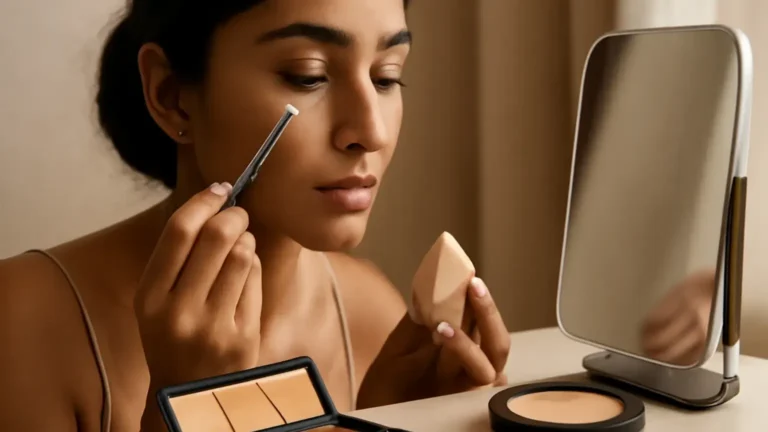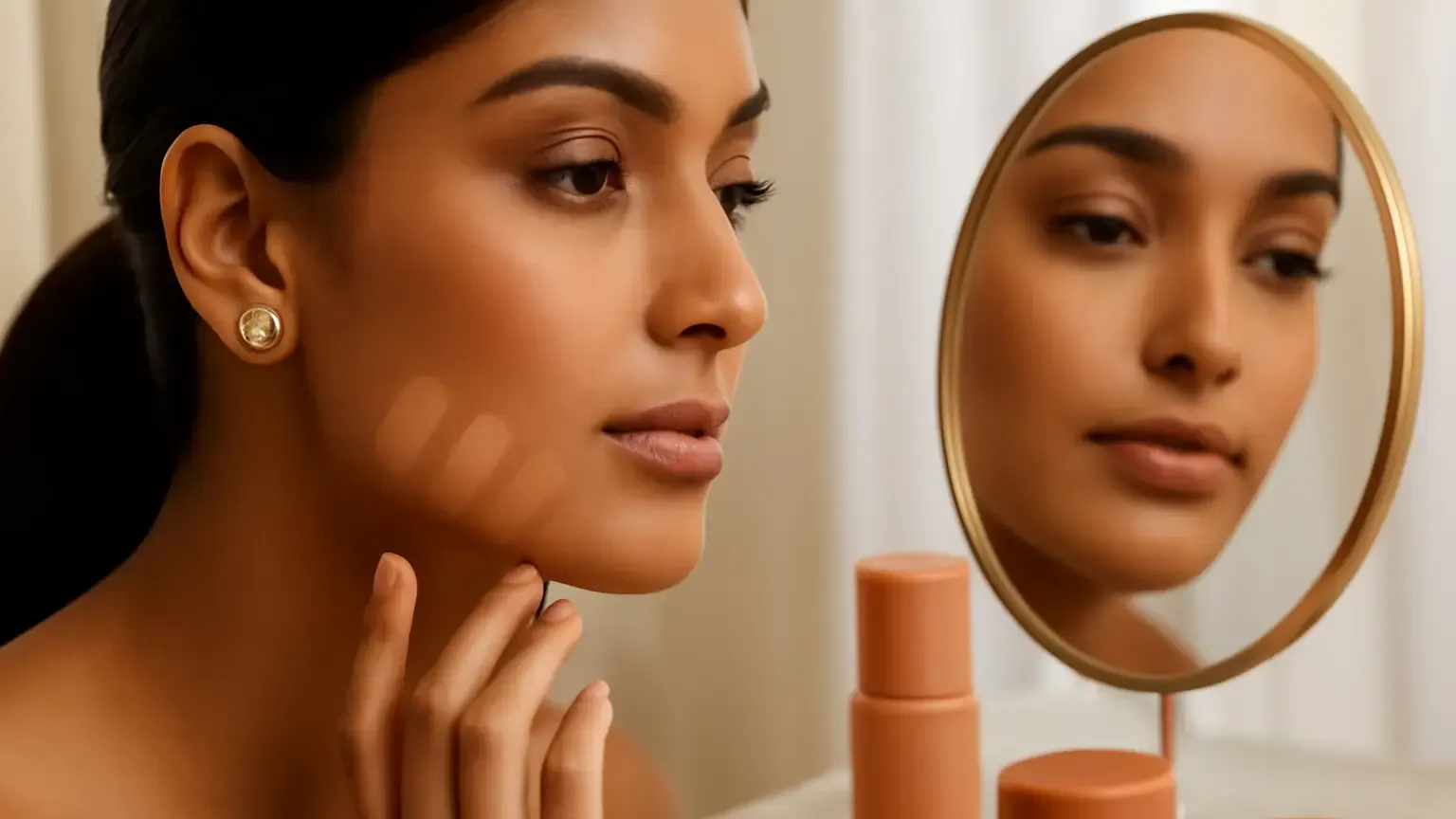
Makeup for Indian Skin Tones becomes easier when you separate two decisions: your skin’s depth, from light to deep, and its undertone, such as warm, cool, neutral or olive. For the quickest reliable match, test two or three foundation shades along your jawline, wait 10 to 15 minutes, and check them in natural daylight. The shade that disappears into both your jaw and neck is usually the strongest starting point. This guide also explains how to choose concealer, blush and lipstick without relying on misleading wrist swatches or overly pale base products.
Start with skin depth, then identify your undertone
The most reliable foundation shade matching process uses two separate measurements. Depth describes how light or deep your complexion appears. Undertone is the subtle colour beneath the surface of the skin. Two people may both have medium skin depth but need different foundation colours because one has golden undertones while the other has neutral or olive undertones.
Indian complexions range from very light to deep, with many people falling across light-medium, medium, tan and dusky categories. Tanning, seasonal sun exposure and pigmentation around the mouth can make the face appear different from the neck, so do not choose a shade from your cheek alone. A medium skin foundation should match the neck and jaw rather than simply being labelled “medium” on a product chart.
Simple clues for Indian skin undertones
- Warm: gold jewellery may look harmonious, veins can appear greenish, and yellow, golden or peach-based products may blend naturally.
- Cool: silver jewellery may be more flattering, veins can look blue or purple, and pink, red or blue-based colours may suit you.
- Neutral: both gold and silver can work, while neither strongly yellow nor strongly pink products looks ideal.
- Olive: the skin may look slightly green, grey or muted beside bright shades. Very pink foundations can look rosy, while very yellow ones can look sallow.
These are starting points, not rules. Lighting, clothing and natural pigmentation can alter how undertones appear. A product swatch on your face is more useful than a wrist test.
For a practical comparison, warm undertone makeup usually includes golden, peach, coral and terracotta colours. Cool undertone makeup may include rosy, mauve, berry and blue-red shades. Neutral undertone makeup can move between both families, depending on the product’s intensity. If your skin looks muted or slightly green, compare olive-friendly neutral or golden shades instead of choosing the most yellow option automatically.
How to find foundation shade for Indian skin
- Begin with your neck and jawline. Pick two or three likely shades based on depth and undertone. Avoid testing only on the hand, which is often darker or lighter than the face.
- Draw narrow stripes from cheek to jaw. Use a thin layer and leave a little space between shades. The best match should visually disappear into both the jaw and neck.
- Wait before deciding. Allow the formula to settle for around 10 to 15 minutes. Some foundations darken or become more orange after contact with air; this is known as makeup oxidisation.
- Check in natural daylight. Step near a window or outdoors without direct harsh sunlight. Indoor yellow bulbs can make a mismatched shade seem acceptable.
- Check the edges. A good shade should not create a visible mask at the jaw, hairline or ears. If the face and neck are slightly different, matching the neck usually creates a more even result.
When shopping online, compare the brand’s shade descriptions, undertone labels and swatches on several skin depths. Look for return or exchange policies where available, but remember that screen settings can change colour. Shade names such as “golden” describe tone, not necessarily how deep the product is.
Recognise a shade that is too pink, yellow, light or deep
Colour mismatch is easier to correct when you know what you are seeing. These signs are particularly useful when comparing makeup shades for Indian skin tones.
| What you notice | Likely issue | What to try |
|---|---|---|
| The face looks rosy, flushed or slightly grey beside the neck | The foundation is too pink or too cool | Try a neutral, golden or olive-leaning shade, depending on your undertone |
| The face looks yellow, orange or unusually sallow | The foundation is too yellow or too warm | Move towards neutral or a less saturated golden shade |
| The complexion looks chalky, ashy or highlighted in the wrong way | The shade is too light | Choose a deeper shade with a similar undertone; do not rely on dark bronzer to fix a pale base |
| The face looks muddy, dull or visibly darker than the neck | The shade is too deep or has oxidised | Try a lighter match, a thinner application or a formula that changes less after setting |
Do not automatically blame undertone when the problem is depth. A foundation can have the right golden tone and still be several shades too light. Conversely, a deeper shade with the wrong undertone may look more noticeable than a slightly imperfect depth.
Choose concealer without creating a pale patch
Concealer shade selection depends on the job. For blemishes or redness, choose a concealer close to your foundation and apply it only where needed. A lighter concealer is optional for brightening the centre of the face, but one that is several shades lighter can look grey or stark on medium and dusky complexions.
For under-eye darkness, a thin salmon, peach or orange corrector may help visually balance blue, purple or brown tones before concealer. This is a form of colour correcting makeup: the corrector is used sparingly to balance the appearance of discolouration, not to replace a well-matched concealer. The deeper the skin tone and the more pronounced the darkness, the more important it is to avoid piling on a pale concealer. Set only where creasing occurs so the area does not become dry-looking.
Test under-eye products in daylight and check them after a few hours. If the area looks grey, the concealer may be too light or too cool. If it looks orange, use less corrector or select a softer peach shade.
Coordinate blush, bronzer and highlighter by skin depth
A balanced base is only part of a flattering look. The most wearable cheek colours have enough saturation to remain visible without sitting as a separate stripe.
Blush for brown skin and medium complexions
- Light to light-medium skin often suits soft peach, apricot, rose and muted pink.
- Medium skin can carry warm coral, terracotta, cinnamon, rose and warm berry.
- Dusky skin makeup often looks lively with terracotta, brick, cranberry, plum, burnt coral and deep berry.
When choosing blush for brown skin, avoid assuming that pale pastel shades will show clearly. If a light blush turns ashy, try a richer version of the same colour. Cream blush can look natural, while powder blush may offer better longevity in humid weather; either can work when applied in thin layers.
Bronzer should add warmth rather than create an orange stripe. Choose a shade only a little deeper than your complexion, and consider neutral brown if warm bronzers look too orange. Highlighter is most harmonious when its base reflects your undertone: champagne or gold for many warm complexions, pearl or rosy tones for cooler complexions, and soft champagne for neutral skin. There are no strict bans, but intensity matters more than a fixed rule.
Find lipstick shades for Indian skin
Among the most useful lipstick shades for Indian skin are colours selected by undertone, depth and contrast. Warm complexions often enjoy caramel nude, peach-brown, terracotta, brick red and orange-red. Cool complexions may suit mauve, raspberry, wine, blue-red and plum. Neutral complexions can move between both groups, while olive skin often works well with muted rose, brown-rose, brick and balanced berry shades.
If nude lipstick makes you look washed out, the colour may be too close to your natural lip tone, too pale or too grey. Try a shade one or two levels deeper, or add a brown, rose or terracotta liner. For naturally pigmented lips, swatch lipstick directly on the lips when possible; arm swatches cannot show how the colour interacts with your lip tone.
Coordinate rather than match every product exactly. For example, a terracotta blush can work with a brown-rose lip, while a berry cheek can be softened with a neutral rose lip. Keep one element stronger and let the others support it.
A practical shopping routine for better shade decisions
- Write down whether your best matches are warm, cool, neutral or olive before browsing products.
- Separate depth from undertone when reading shade names. “Golden” describes tone, not necessarily how deep the shade is.
- Test the smallest reasonable amount on the jawline, not the wrist.
- View the swatch in daylight, indoor light and a phone camera if you will wear it for photographs.
- Wait for the formula to settle and check whether it oxidises.
- Build the rest of the look around the base: use richer cheek colours for deeper skin and avoid concealer that is dramatically paler than the foundation.
Patch test new cosmetics according to the product directions, especially if your skin is easily irritated. Stop using a product if it causes persistent discomfort. For ongoing or severe skin concerns, seek advice from a qualified dermatologist rather than trying to cover the issue with more makeup.
Common mistakes to avoid
- Matching the hand: hands are exposed differently and rarely represent the face and neck.
- Choosing the lightest shade: a pale base is not automatically brighter or more flattering.
- Ignoring oxidation: a shade that looks perfect immediately may deepen after it sets.
- Using one concealer for every task: spot concealing and under-eye brightening need different levels of coverage and brightness.
- Following a celebrity shade: similar-looking complexions can have different undertones, pigmentation and lighting.
Takeaway: The best Makeup for Indian Skin Tones is chosen by matching both depth and undertone, then verified on the jawline in natural light after the formula settles. Once the base is right, coordinate cheek and lip colours by saturation and contrast rather than relying on rigid colour rules.
Products that may help with this routine
Choose only what fits your skin, hair or personal needs. Use the links below to view current options on Amazon India.
Frequently Asked Questions
How do I find foundation shade for Indian skin?
Test two or three shades in narrow stripes from the cheek to the jawline. Choose the one that blends into both your face and neck, then check it in natural daylight after 10 to 15 minutes to account for oxidation.
What are the best makeup shades for warm Indian undertones?
Warm Indian undertones often suit golden or neutral-golden foundation, peach and terracotta blush, bronze or champagne highlighter, and lipstick in brick, caramel, warm rose, coral or orange-red.
How do I choose concealer for Indian skin tone?
Use a close foundation match for blemishes. For under-eye darkness, apply a thin peach, salmon or orange corrector if needed, followed by concealer that is only slightly lighter rather than dramatically pale.
What makeup works well for dusky Indian skin?
Dusky complexions often suit richly pigmented but blendable colours such as terracotta, burnt coral, cranberry, plum, brick and deep berry. Choose foundation by matching the neck and undertone, not by selecting a lighter shade.
How should I test foundation shade in natural light?
Apply thin swatches along the jawline, wait for the formula to settle, and view them near a window or outdoors without direct harsh sunlight. The closest match should visually disappear into the neck.
Which blush suits medium Indian skin?
Medium Indian skin often works well with coral, terracotta, cinnamon, rose, warm berry and muted pink. If a colour looks ashy, choose a richer or more saturated version.