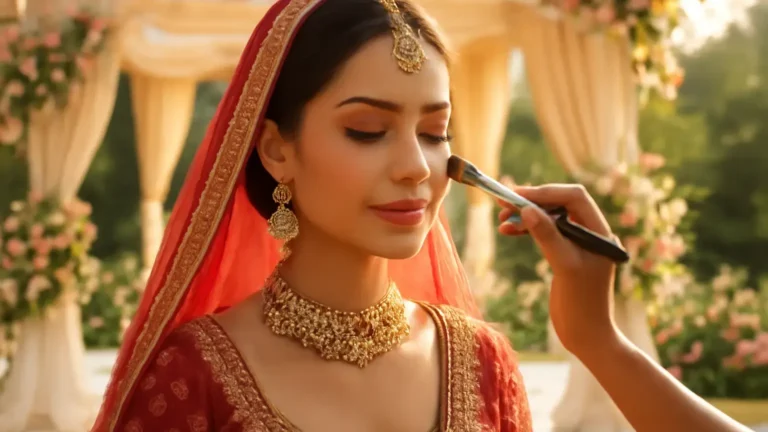
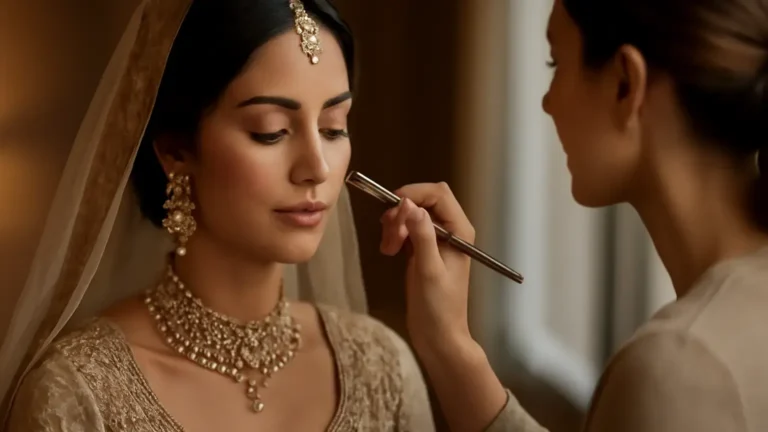
Bridal Makeup for Mature Skin works best when it improves tone without masking natural texture. This guide is for brides and family members who want comfortable, polished coverage that holds up in Indian daylight, indoor venues and flash photography. The key decision is not full versus light coverage; it is where to place thin layers, where to use cream formulas and where a small amount of powder will prevent shine without making the complexion look flat.
Mature skin can look radiant in wedding photographs when makeup is treated as a balance of preparation, controlled coverage and carefully checked texture. The goal is not to erase every line. It is to even out redness or discolouration, add definition and keep the skin looking like skin from close range as well as in portraits.
Start with skin preparation, not foundation
Good skin preparation for bridal makeup creates a smoother surface and reduces the need for heavy base products. On the morning of the wedding, keep the routine familiar. Cleanse gently, apply a moisturiser suited to your skin and allow each layer to settle before makeup begins. If your skin feels tight, a little extra moisturiser on the cheeks may help; if the T-zone becomes oily, keep that area lighter.
A hydrating primer can be useful on areas that look dry or textured, but it should not be applied automatically across the whole face. Use a thin layer and wait a few minutes. Silicone-rich smoothing primers may help around visible texture, while a luminous primer can add freshness to the high points. Avoid trying a new active skincare product immediately before the ceremony, since unfamiliar formulas may cause irritation or pilling.
What to check before the base goes on
- Moisturiser has absorbed rather than sitting visibly on the skin.
- Sunscreen, if being used, does not pill under the chosen foundation.
- Dry patches are softened without leaving a slippery film.
- The face and neck look close in tone under the venue’s actual lighting.
Build coverage in thin foundation layers
For most brides, thin foundation layers photograph more naturally than one thick application. Begin at the centre of the face, where redness and uneven tone are often more noticeable, then blend outward with a damp sponge or a flexible foundation brush. Leave the outer cheeks and areas with minimal discolouration lighter. This preserves dimension and limits product settling into fine lines.
The best foundation for mature skin bridal makeup is usually one that matches the desired finish and wears comfortably, rather than the heaviest or most full-coverage formula available. A natural-satin or soft-matte base often performs well because it controls shine without removing all luminosity. Very dewy formulas may reflect too much light on the forehead or nose, while an intensely matte base can emphasise dryness.
Correct specific concerns before adding more foundation. A small amount of peach or salmon corrector may help neutralise bluish or brownish darkness, depending on the individual skin tone. Apply it only where needed, then tap concealer over it. More product is not automatically more coverage; excess layers can crease, separate or appear pale under flash.
Use cream textures for believable colour
Cream blush and cream bronzer can blend into mature skin more seamlessly than dry powders, particularly when the complexion has some dehydration. Place blush slightly higher on the cheeks and blend towards the temples to create lift in photographs. Choose a shade that remains visible after foundation but is not so intense that it needs repeated layering.
For a longer-lasting result, cream colour can be lightly reinforced with a coordinating powder product. The powder should be pressed, not swept heavily across the face. Avoid applying shimmer directly over pronounced lines or uneven texture; a soft satin finish gives dimension without drawing attention to every surface change.
Powder only where it earns its place
Strategic powder placement is one of the most important techniques in bridal makeup for women over 40. Use a small, soft brush or puff to set the sides of the nose, the centre of the forehead, the chin and any area that becomes shiny. Keep the cheeks and the outer eye area less powdered when possible, because these zones can look dry or flat when overloaded.
Under the eyes, use the smallest amount needed. Apply under-eye concealer in a thin layer, blend it close to the darkness rather than covering the entire under-eye, and give it a moment to settle before pressing away excess. A very light veil of finely milled powder can reduce creasing, but repeatedly baking this area is rarely flattering on textured skin.
Define the eyes without making them heavy
Wedding eye makeup should remain visible when the bride smiles, looks down or appears in a group photograph. Soft eye definition usually means a mid-tone matte or satin shadow through the crease, a slightly deeper shade close to the lash line and careful blending at the outer corner. This creates shape without requiring a thick, hard-edged line.
For mature lids, map the eye with the lid relaxed rather than only when the eye is closed. If the fold partially covers the mobile lid, place some transition colour just above the natural crease so the definition remains visible. Curling the lashes and using waterproof eye makeup can help during emotional moments, but check that the mascara and liner are comfortable and do not flake.
Keep the inner corner softly bright rather than extremely glittery. A satin highlight can open the eye in photographs, while chunky sparkle may emphasise texture or scatter unpredictably under flash. Brows should be filled with fine, hair-like strokes and set without creating an overly solid block.
Adjust the finish for daylight and evening ceremonies
Daylight bridal makeup
Daylight bridal makeup needs restraint because natural light reveals edges, texture and colour differences clearly. Use a lighter hand with foundation around the hairline and jaw, then inspect the face near a window. Blush and lip colour may need slightly more saturation than they appear to have indoors, but the base should not be made heavier simply because the camera is present.
For an outdoor ceremony in India, consider heat and humidity. Keep skincare layers thin, choose a comfortable long-wearing base and set only high-shine areas. Blotting papers can remove oil without adding more powder. A small touch-up kit with lipstick, a cotton bud, blotting paper and a pressed powder is more useful than carrying several complexion products.
Evening bridal makeup
Evening bridal makeup can support a little more contrast around the eyes and lips because venue lighting is often warmer or lower. Even so, do not compensate for dim light with a pale foundation or excessive highlighter. Check the finished face under the venue’s warm lights and under a neutral white light if available.
Some flash photographs can make certain sunscreens, powders or pale correctors appear lighter than expected. This is why a controlled flash photography makeup check matters. It is not a reason to avoid sun protection in everyday life; it is a reason to test the complete wedding look, including skincare, base, powder and highlighter, before the event.
Make the bridal makeup trial a lighting test
A bridal makeup trial should assess more than whether the makeup looks attractive in a mirror. Wear the look for several hours if possible. Take photographs in front-facing daylight, indoor warm light and with the phone’s flash. Look at close-ups and full-length images. Check whether the foundation has separated, whether blush remains visible and whether the under-eye area has gathered product.
Ask the artist to record the products, shades and application order. If the ceremony and reception use different lighting, plan a small adjustment rather than a complete change. For example, the same thin base may need more strategic powder for a humid daytime event and slightly stronger eye definition for an evening reception.
Common mistakes to avoid
- Using a thick layer everywhere: Full coverage is often better achieved through targeted correction and selective layering.
- Powdering the entire face heavily: This can reduce natural dimension and highlight dry texture.
- Testing only in salon lighting: Venue light, window light and flash can produce very different results.
- Choosing a shade that is too light: A pale base may look obvious against the neck and become more noticeable in photographs.
- Trying new skincare just before the wedding: Familiar, well-tolerated products are the safer choice for an important event.
- Ignoring comfort: If the eyes water or the skin feels tight during the trial, the formula or preparation needs reconsideration.
Concise takeaway
Successful Bridal Makeup for Mature Skin is selective rather than minimal: prepare the skin well, build coverage in thin layers, use cream colour for softness, powder only high-shine zones and define the eyes with controlled contrast. A trial photographed in daylight, indoor light and flash will reveal more than a mirror alone. If persistent redness, swelling, itching or another concerning skin symptom is present, consult a qualified dermatologist before the wedding rather than attempting to conceal or treat it with unfamiliar products.
Products that may help with this routine
Choose only what fits your skin, hair or personal needs. Use the links below to view current options on Amazon India.
Frequently Asked Questions
How do you do bridal makeup for mature skin?
Prepare with familiar moisturiser and a suitable primer, then apply thin foundation layers mainly where coverage is needed. Use cream blush, minimal under-eye concealer, strategic powder and soft eye definition. Test the complete look in daylight, indoor lighting and flash before the wedding.
What is the best foundation for mature skin bridal makeup?
A comfortable natural-satin or soft-matte foundation that matches the face and neck is usually a practical choice. The best formula depends on skin comfort, coverage needs, humidity and the desired finish, so test it during a bridal makeup trial rather than choosing only by coverage claims.
How can I stop bridal makeup settling into wrinkles?
Keep skincare and foundation layers thin, allow moisturiser and primer to settle, and avoid applying excess product to lines or the outer eye area. Use a small amount of concealer and powder only where creasing or shine is most noticeable.
What makeup looks best on mature skin for a wedding?
Natural-satin skin, softly blended cream colour, controlled powder and gently defined eyes usually photograph well. The most flattering finish is one that balances comfort, texture and lighting rather than being completely matte or highly glossy.
How can I make bridal makeup photograph well?
Have a trial photographed in window daylight, warm indoor lighting and flash. Check the face and neck match, keep powder targeted, avoid excess pale corrector or highlighter, and review close-up images after the makeup has worn for several hours.