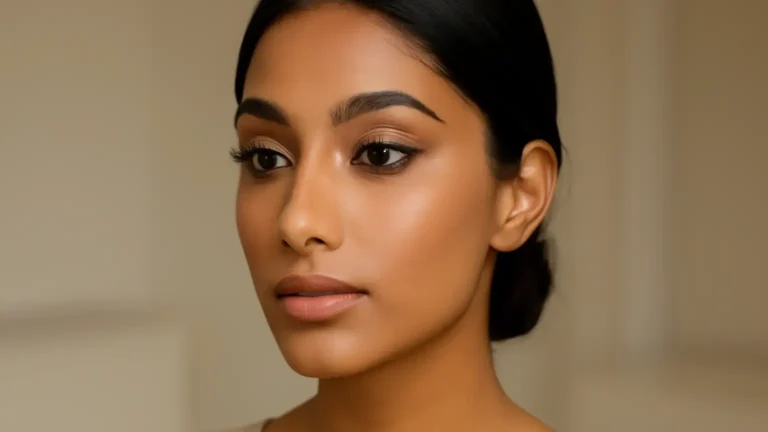
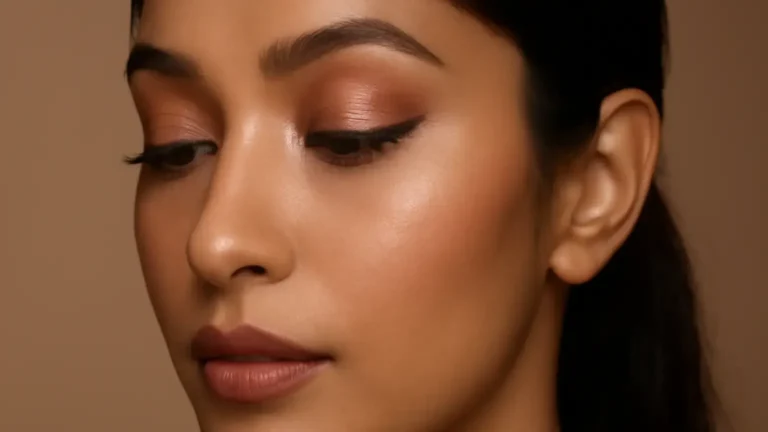
Eye Makeup for Close Set Eyes works by shifting visual emphasis outward: keep the inner corner bright and light, build colour through the outer third, and angle liner and mascara toward the temples. This guide is for anyone whose eyes sit relatively close together and wants a balanced result—not to make one eye shape seem better than another. Use the softer placement for daytime, then add richer colour and a sharper wing for festive definition.
Close-set eyes are positioned with less space between them than the width of one eye, although real faces vary widely. Makeup is not about correcting or disguising that feature. It is about distributing light, shade and direction so the whole eye area feels intentional and balanced.
The most useful rule is simple: place brightness near the nose, concentration near the outer corner, and upward movement along the lash line. That combination can make the eyes appear more open and separated while still preserving their natural character.
Start with placement, not a fixed eye-makeup rule
Before choosing a palette, look at where your visible eyelid begins and ends, how much lid space you have, and whether your crease or brow bone changes the way colour appears. If you have a hooded lid, a deep crease or a monolid, the same outward-balancing idea still applies, but the visible placement may need to sit slightly above the fold.
Apply both eyes together in small stages. A light wash on one side can look even at first and then become noticeably stronger after blending. Checking your makeup with your eyes open is particularly important for hooded lid adaptation, because a wing or crease colour can disappear when the eyes relax.
Eye Makeup for Close Set Eyes: the placement map
1. Brighten the inner corner carefully
Use a pale champagne, soft gold, ivory or light satin shade at the tear duct and extend it only a short distance onto the inner lid. This inner corner highlight catches light without creating a hard white dot. For daytime, choose a finely milled matte-satin or subtle shimmer. For an evening look, a more reflective finish can work, provided it does not irritate your eyes or emphasise texture you would rather leave understated.
Keep the inner third relatively clean. Dark shadow placed right beside the nose can pull attention inward, particularly when it is paired with heavy lower-lash-line colour. A warm beige or light peach transition shade can still be used there, but blend it softly toward the centre rather than packing it into the tear duct.
2. Build the outer corner gradually
Place your medium transition shade from the centre of the crease toward the outer third. Then add a deeper brown, plum, bronze or charcoal shade to the outer corner in a small lifted V. This outer corner eyeshadow creates depth where you want the eye to travel.
Keep the deepest colour at the outermost point and soften its inner edge. The shape should look elongated, not like a dark block. A fluffy blending brush gives a hazy daytime finish; a smaller tapered brush creates the more defined edge useful for festive eye makeup.
Liner placement that opens rather than closes the eyes
The most flattering winged eyeliner placement usually starts thin at the inner lash line and becomes slightly fuller from the centre outward. You can begin the visible liner at the middle of the upper lash line if a full inner-to-outer line makes the eyes look crowded. Keep the inner end close to the lashes rather than drawing a wide triangular point.
For the wing, follow the direction of the lower lash line for a short lift, then connect it back into the upper line. A wing that extends straight sideways can look heavier, while one that curves sharply upward may appear disconnected. Adjust the length to your lid space and occasion: a small brown flick is enough for day, while a black or deep-plum wing can support a festive look.
When to use tightlining
A careful tightlining technique can fill gaps between the upper lashes without adding a thick visible border. Keep it mainly through the centre and outer half. Avoid forcing product into the waterline if your eyes are sensitive, watery or easily irritated. Use a clean, eye-safe product and remove it gently at the end of the day.
Brows and mascara: the balance comes from direction
Brow shaping for eye balance does not mean changing your natural brow into a dramatic arch. Keep the inner brow soft and avoid extending the front too far toward the nose. Brush the hairs upward and slightly outward, then define the arch and tail without making the tail disproportionately long or low. A softly lifted tail helps echo the outward movement of the eye makeup.
Curl the lashes before mascara and focus the most visible coats on the centre and outer lashes. A lengthening mascara swept diagonally toward the temples reinforces the effect. If your lashes clump, separate them before adding another coat. Heavy, rounded volume concentrated at the inner lashes can counteract the spacing you are trying to create.
For a more polished evening result, individual or outer-corner false eyelashes for close set eyes can add length without covering the inner lid. Trim a strip lash to fit rather than forcing its inner edge too close to the tear duct. Choose a lightweight style and stop using it if the adhesive causes stinging, redness or discomfort.
Two routines for different occasions
Soft daytime eye makeup
- Prepare the lids with a thin layer of primer or concealer, then set only if creasing is a concern.
- Wash a light matte beige or peach shade across the lid and softly through the crease.
- Add a medium taupe, caramel or soft brown shade from the centre crease to the outer corner.
- Tap a subtle champagne highlight at the inner corner and a little on the centre lid.
- Line the upper lashes thinly from the centre outward, finishing with a short brown wing.
- Curl the lashes and comb mascara outward, keeping the inner lashes defined but lighter.
This is an easy daytime eye makeup approach for work, college, errands and daytime events. It gives definition without relying on a strong contrast between the eyes.
More defined festive eye makeup
- Use a long-wearing eye base and place a warm transition shade slightly above the natural crease if the lid is hooded.
- Press bronze, copper, rose-gold or jewel-toned shimmer onto the centre and outer lid, leaving the inner corner lighter.
- Deepen the outer V with espresso, plum or charcoal, keeping the darkest point toward the temple.
- Create a slim black or deep-brown wing that follows the lower lash-line direction.
- Add a controlled inner-corner highlight and a little brightness beneath the brow’s highest point.
- Finish with separated, outward-swept mascara or an outer-corner lash accent.
This festive eye makeup version adds contrast and shine while retaining the same placement logic. If you wear glasses, check the look from a normal distance; excessive shimmer or a very long wing may compete with the frames.
Common eye makeup mistakes to avoid
- Making the inner corner too dark: intense black or deep brown beside the nose can visually narrow the gap.
- Using the same intensity everywhere: equal darkness across the entire lid removes the outward flow created by graduated colour.
- Drawing a thick inner liner: this can reduce visible lid space and make the eye area feel crowded.
- Extending the lower liner too far inward: keep lower-lash definition mainly from the centre to the outer third, then soften the edge.
- Overextending the brows at the front: a long, heavily filled inner brow can bring the visual focus back toward the nose.
- Ignoring the open-eye view: crease placement should be checked while looking straight ahead, especially for hooded or low-lid space.
How to choose products and finishes
Choose formulas according to comfort, climate and the finish you want. In warm or humid Indian weather, a thin eye primer can help powder shadow adhere, but layering too much base may encourage creasing. Matte and satin shadows are generally easier to control in the crease; shimmer is most effective when concentrated on the centre or outer lid rather than spread across every surface.
Brown liner is often more forgiving for daytime, while gel or liquid liner gives a crisp festive edge. If your eyes water, prioritise gentle removal and avoid repeatedly rubbing the inner corner. Remove eye makeup before sleeping with a suitable remover, using light strokes and a clean cotton pad or reusable cloth.
A quick decision guide for balanced definition
Choose soft diffusion when you want an understated result: light inner corner, neutral crease, short outer flick and outward-combed mascara. Choose structured definition when you want more drama: brighter inner-corner shimmer, deeper outer shadow, a precise lifted wing and an outer-lash accent.
If your lids are small, reduce the height of the dark crease colour and use a thinner liner. If your eyes are hooded, place the transition shade where it remains visible with your eyes open. If you prefer a rounder appearance, keep the outer wing short and put more emphasis on centre-lid brightness. These adjustments show that eye makeup to widen close set eyes is not one rigid formula; direction and proportion matter more than copying a particular look.
Takeaway
The best Eye Makeup for Close Set Eyes uses a light-to-deep gradient from inner corner to outer corner, a thin-to-lifted liner, softly outward-directed brows and mascara concentrated toward the temples. Keep the inner area fresh, build depth gradually outside, and adapt the intensity to your lid shape, comfort and occasion. The aim is visual balance—not to make your natural eye spacing conform to a single ideal.
Products that may help with this routine
Choose only what fits your skin, hair or personal needs. Use the links below to view current options on Amazon India.
Frequently Asked Questions
How do I apply eye makeup for close set eyes?
Keep the inner corner light, blend medium colour from the centre toward the outer crease, deepen the outer corner, and use a thin liner that lifts slightly at the end. Sweep mascara outward rather than concentrating heavy volume near the nose.
How can I make close set eyes look wider with makeup?
Use a subtle inner-corner highlight, avoid heavy dark colour on the inner third, place deeper shadow on the outer third, and extend liner and mascara toward the temples. Keep the lower-lash definition mainly on the centre and outer half.
What is the best eyeliner placement for close set eyes?
Start with a thin line at the centre of the upper lash line and gradually thicken it toward the outer corner. Finish with a short wing following the angle of the lower lash line. A full, thick inner line can make the eyes look more crowded.
Is there a good daytime eye makeup look for close set eyes?
Yes. Use a light beige or peach wash, soft brown outer-corner shadow, a subtle inner-corner highlight, brown liner from the centre outward and outward-swept mascara. This creates definition without a heavy contrast.
Where should I put eyeshadow on close set eyes for a festive look?
Keep the inner corner and inner lid lighter, place shimmer across the centre or outer lid, and use a deeper shade in the outer V. Blend the crease colour outward and finish with a controlled lifted wing or an outer-corner lash accent.