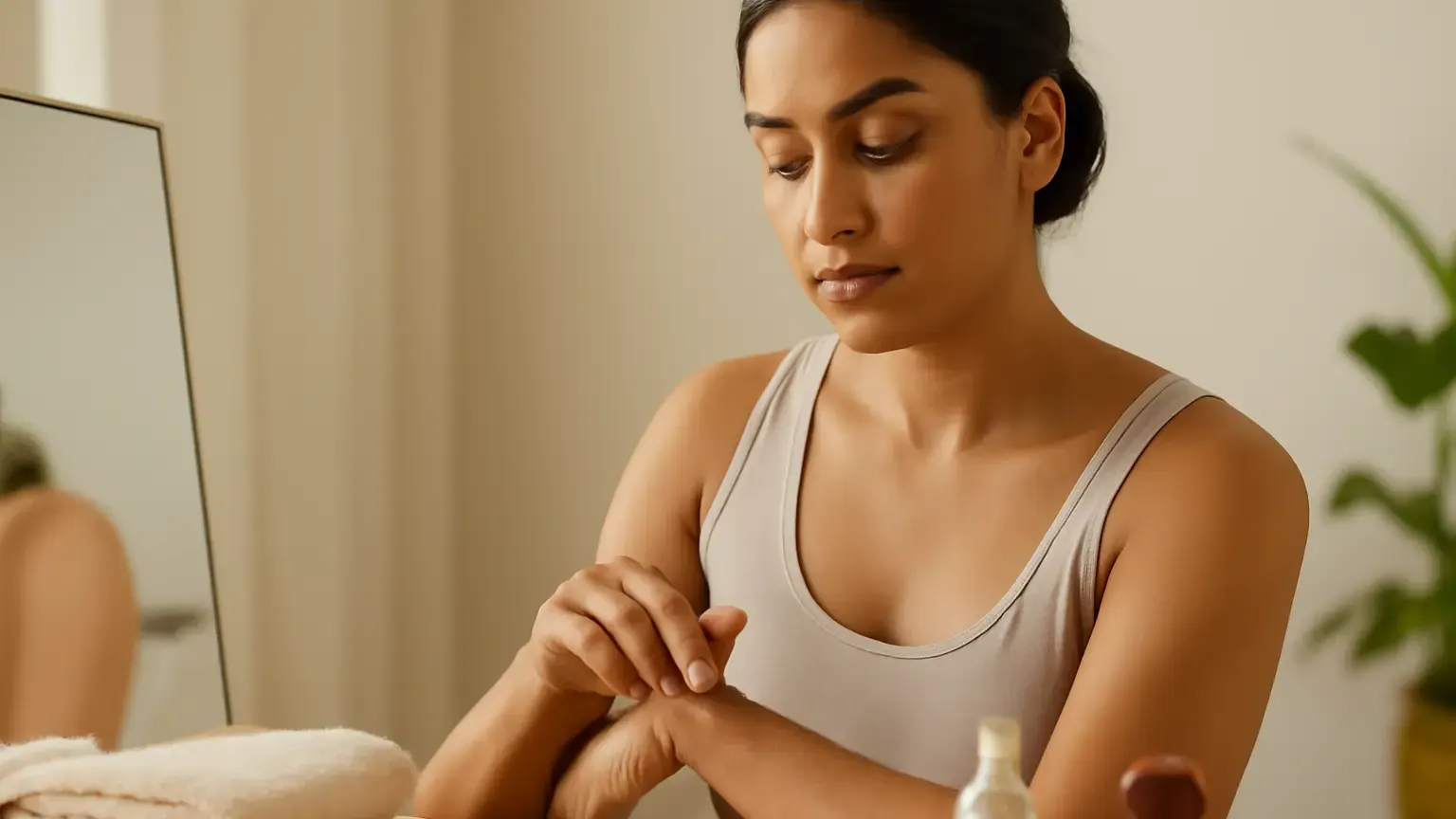
These skin care tips for patch testing give you a simple answer before an important event: test one unfamiliar product on a small area of clean, intact skin at least seven days early, follow its label directions, and stop if you notice redness, itching, burning or swelling. This approach can reduce the risk of a last-minute reaction from a cleanser, active, makeup product or hair-removal formula, although no home patch test can guarantee that your face will not react.
A patch test is a small-scale trial of a product on limited skin before wider use. It is a practical form of product reaction prevention, not a guarantee of safety. Your face, eyelids, lips and freshly hair-removed skin may respond differently from your forearm or the area behind your ear.
When to patch test before an event
Start at least seven days before a wedding, party, holiday, photoshoot or important work event whenever possible. This gives you time to notice an immediate response, monitor delayed redness or itching, and return to a familiar routine if the product does not suit you. Some reactions appear within minutes; others become clearer over 24 to 72 hours.
For reliable skincare product safety, introduce only one unfamiliar formula at a time. Changing a cleanser, serum, moisturiser and makeup product together makes it difficult to identify the trigger. A calm pre-event skincare routine is usually safer than a last-minute attempt to overhaul your skin.
Where to patch test skincare products
Patch testing on inner arm skin is convenient because the area is easy to monitor and usually less exposed than the face. A behind-the-ear patch test is another option, particularly for hair products, fragrance or a product likely to touch the sides of your face. Both locations can provide useful information, but neither replaces professional allergy testing.
- Choose clean, dry skin without cuts, sunburn, rashes or recent waxing.
- Use a small amount in the way the product is intended to be used.
- Mark the area discreetly so you do not accidentally apply another product over it.
- Do not test several new formulas in the same patch.
- Record the product, time and location in your phone.
This skin sensitivity test should not be performed on an already irritated skin barrier. If the area is unusually dry, sore or recently over-exfoliated, wait until it feels comfortable. For products intended near the eyes or lips, keep the test away from the eye itself, waterline and broken skin. Always follow label-specific instructions, because some products should not remain on the skin during testing.
How to patch test skin care by product type
Testing facial cleansers
Testing facial cleansers differs from testing a leave-on serum. Apply a small amount to the selected area, leave it only for the label-recommended contact time, then rinse thoroughly. Check the skin immediately and again over the next 24 to 48 hours. Tightness, persistent stinging or visible redness during a short trial may indicate that the cleanser is not a good choice for your face.
Do not rub the patch vigorously to imitate cleansing. Friction can create redness and make the result difficult to interpret. This is also the answer to how to patch test facial cleanser before using it: use a small amount, respect the contact time, rinse gently and observe rather than scrubbing or repeating the test.
Introducing active ingredients
Acids, retinoids, vitamin C formulas and other concentrated treatments need extra caution. Apply a tiny amount to the test area and follow the instructions instead of leaving the product on longer to “make sure”. Observe for at least 48 hours, and consider a longer observation window for a product you plan to use repeatedly.
Introducing active ingredients one at a time makes cosmetic ingredient sensitivity easier to identify. A small patch that looks fine does not prove that an active is suitable for your entire routine. Combining several strong products may increase dryness or irritation, so avoid pairing an unfamiliar active with other exfoliants immediately before an event.
Makeup allergy precautions
For foundation, concealer, primer or cream blush, apply a small amount near—but not directly on—the jawline or behind the ear if the product will be worn on the face. These makeup allergy precautions are useful for complexion products, but a forearm test cannot fully predict sensitivity around the eyes.
Be particularly cautious with new mascara, eyeliner, glitter and lash adhesive. Check applicators, expiry guidance and shared tools. Where the label allows, wear the test product for roughly the period you expect to wear it, then check the skin after removal. If it causes watering, swelling, itching or a burning sensation, wash it off and do not retry it for the occasion.
Hair removal cream test
A hair removal cream test is important because depilatory formulas can irritate skin even when used correctly. Follow the package directions for the test location, amount, contact time and waiting period. Never exceed the stated time, apply the cream to broken or sunburned skin, or use it on an area the product does not list.
If you plan to remove facial hair, do not assume that a leg or arm test clears the product for facial use. Facial skin may respond differently, and some depilatory creams are not designed for the face. Avoid scheduling hair removal immediately before an event; a conservative buffer gives temporary redness time to settle. For anyone asking how to test hair removal cream safely, the label’s method and timing take priority over a generic home routine.
How long to patch test a new skincare product
There is no single observation period for every formula. As a practical guide:
| Product | Basic approach | Observation guide |
|---|---|---|
| Rinse-off cleanser | Apply briefly, then rinse | Check immediately and over 24–48 hours |
| Moisturiser or sunscreen | Apply a thin layer | Observe for 24–48 hours |
| Active serum or exfoliant | Use a very small amount as directed | Observe for at least 48–72 hours |
| Makeup | Test a small amount and remove gently | Check during wear and after removal |
| Hair-removal product | Follow the label’s exact test method | Respect the stated waiting period, often 24 hours |
These are general decision aids, not universal rules. The product label takes priority because contact time differs by formula. A delayed response can include itching, redness, roughness, warmth or swelling after the first application appears normal.
What to do if a patch test reacts
Stop the trial if you feel significant burning, increasing stinging, itching, swelling, hives, blistering, marked redness or pain. Remove a leave-on product gently with lukewarm water. For a rinse-off formula, rinse thoroughly without scrubbing. Do not apply more product to “confirm” the reaction.
If you are wondering what to do if a skincare patch test reacts, keep the rest of your routine simple while the area settles. Avoid adding another new product, fragrance or exfoliant to that spot. Choose familiar products for the event instead of trying to rescue the result with another treatment.
If symptoms are severe, spreading, persistent, involve the eyes or lips, or include breathing difficulty, seek prompt medical help. A dermatologist or doctor is appropriate for repeated reactions, unexplained sensitivity or a persistent rash. This general guidance does not replace individual medical advice.
Common patch-testing mistakes before a special occasion
- Testing on already irritated skin: this can worsen discomfort and produce a misleading result.
- Trying a full face immediately: a small test limits the area exposed if the formula is unsuitable.
- Testing everything together: change one product at a time so the likely trigger is easier to identify.
- Ignoring the label: contact time matters for cleansers, masks and depilatory products.
- Testing on event morning: even a familiar-looking product can cause delayed redness.
- Using a test as a guarantee: facial skin, eyelids and freshly hair-removed areas can respond differently.
A simple pre-event patch-testing routine
Seven or more days before the event, list only the products you genuinely need. Test the highest-risk or most unfamiliar formula first on clean, intact skin on the inner forearm or behind the ear. Check at several points during the first day and again over the next two days. If the label specifies a different method, follow that method instead.
If there is no concerning response, use the product conservatively as directed rather than increasing the amount. Keep a familiar cleanser and moisturiser available as a fallback. In the final 48 hours, prioritise consistency: do not add a new peel, facial, hair-removal product or heavily fragranced formula simply because it promises a quick refresh.
Takeaway: skin care tips for patch testing
Test early, use a small area, follow product-specific directions and observe beyond the first few minutes. Cleansers, active ingredients, makeup and hair-removal products each need slightly different handling. If the area reacts, remove the product and choose a familiar alternative for the event. The most useful skin care tips for patch testing support a low-risk routine rather than a last-minute experiment.
Products that may help with this routine
Choose only what fits your skin, hair or personal needs. Use the links below to view current options on Amazon India.
Frequently Asked Questions
How long to patch test a new skincare product?
Observe most leave-on skincare products for 24 to 48 hours, and give strong active ingredients at least 48 to 72 hours when the label allows. Follow the product instructions first because contact time differs by formula.
Where to patch test skincare products?
Use a small area of clean, intact skin on the inner forearm or behind the ear. Do not test over cuts, sunburn, rashes or recently waxed skin, and keep products away from the eyes.
How to patch test facial cleanser before using it?
Apply a small amount to the inner forearm or behind the ear, leave it on only for the recommended contact time, rinse well and check the area immediately and over the next 24 to 48 hours.
Can you patch test makeup before an event?
Yes. Test a small amount of face makeup near the jawline or behind the ear several days beforehand, then check during wear and after removal. Be especially cautious with new eye makeup and lash adhesive.
How to test hair removal cream safely?
Follow the package directions for the test area, amount, contact time and waiting period. Never exceed the stated time or use the formula on broken, sunburned or unauthorised areas. A body test does not automatically clear a product for facial use.
What to do if a skincare patch test reacts?
Stop the test, gently rinse off a leave-on product and avoid scrubbing or reapplying it. Keep the routine simple. Seek medical advice for severe, spreading or persistent symptoms, eye or lip involvement, or breathing difficulty.



