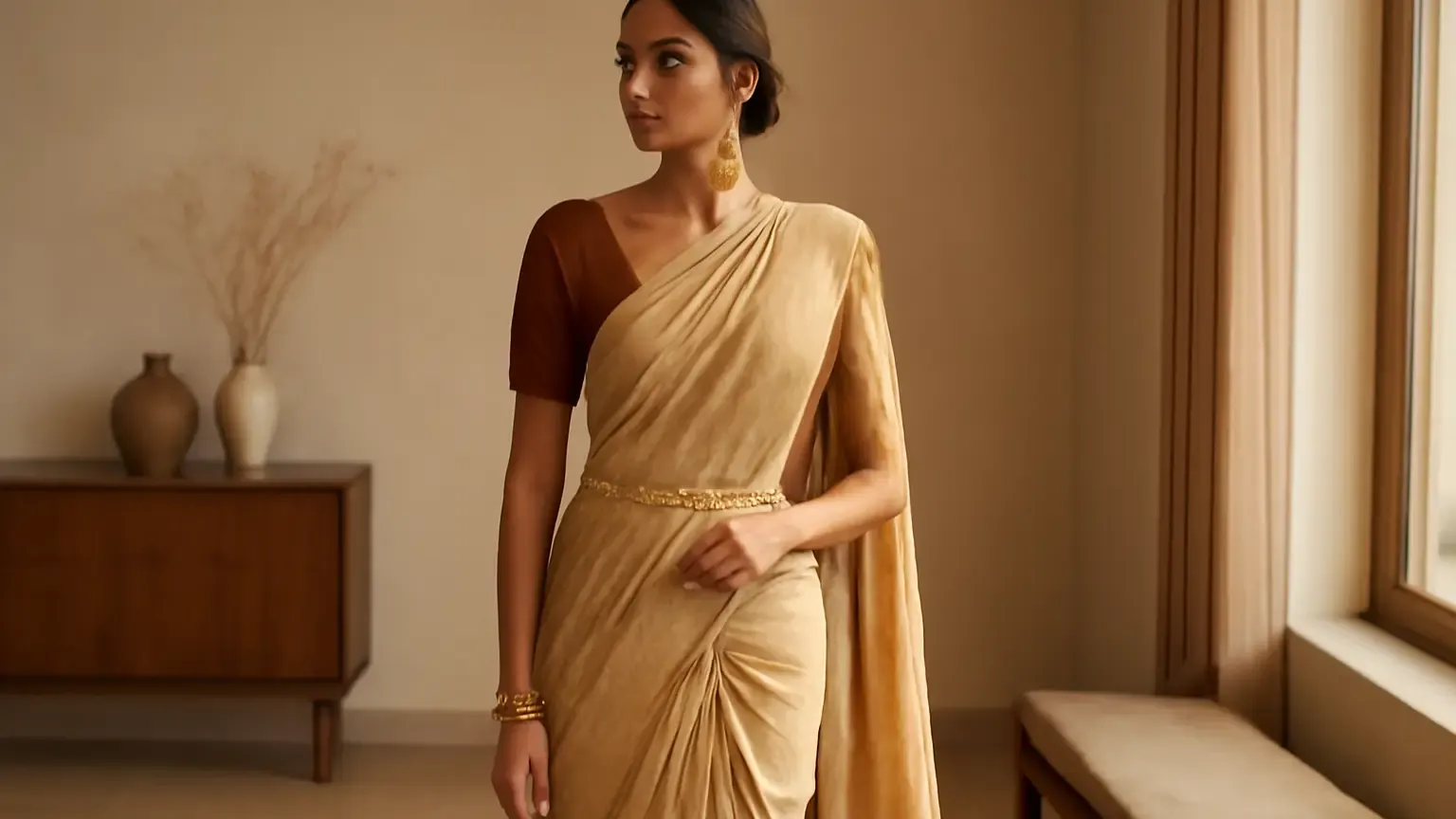
Saree styling with belt works best when the belt supports the tuck line instead of squeezing the whole drape. This guide is for anyone dressing for weddings, work or festive gatherings who wants sharper pleats, a controlled pallu and comfortable movement. Choose the belt after considering the saree fabric and blouse, place it at the natural waist or slightly above the pleats, then test sitting and walking before finalising the look.
A belt can make a saree look intentional, modern and easier to manage, but it should not turn a fluid drape into a stiff column. The most flattering result comes from treating the belt as a finishing support: it holds the front structure, frames the waist and lightly anchors the pallu while allowing the fabric to move.
What a belt should do to a saree
A saree belt is useful when the drape needs light control. It can stop the upper pleats from opening, reduce repeated pallu adjustments and create a clear waistline over a simple or statement blouse. It is not a substitute for a secure petticoat tuck or careful saree pinning techniques. If the foundation is loose, the belt may hide the problem briefly but can also pull the saree out of alignment.
The ideal finish has three qualities: the belt sits securely without digging in, the pleats remain recognisable below it and the pallu still falls in a natural line. A narrow belt gives subtle definition, while a wider belt creates a stronger fashion silhouette and needs more attention to blouse balance.
Saree styling with belt: choose placement before decoration
Saree belt placement determines whether the outfit looks polished or compressed. For most drapes, position the belt at the natural waist, where the torso naturally narrows. This usually means placing it over the top of the front pleats and around the body, rather than directly across the fullest part of the hips.
- Natural waist: The safest choice for a classic drape and most body proportions. It secures the pleats without shortening the visible torso too much.
- Slightly above the waist: Helpful with a high-waisted blouse or when you want a longer-looking lower half. Keep the pallu broad enough to avoid a crowded upper body.
- On the pallu only: A softer option for lightweight sarees. The belt can sit where the pallu crosses the waist, but do not tighten it enough to create horizontal creases.
Stand naturally while placing the belt. Do not hold your stomach in or raise your shoulders, because the fit will change as soon as you relax. Fasten it firmly enough to stay in place, with room for normal breathing and a comfortable seated position.
Build neat pleats without making them flat
Good saree pleat control starts before the belt is added. Tuck the inner end securely into the petticoat, make even front pleats and check that their lower edges fall at a similar length. Pressing or lightly arranging the pleats with your hands is usually more effective than pulling them tight.
- Complete the basic wrap and secure the initial tuck.
- Make five to seven front pleats, depending on the saree’s width and fabric behaviour.
- Align the pleat bottoms and tuck them slightly to one side of the navel for a clean front line.
- Pin the pleats from the inside or at a concealed point if the fabric tends to separate.
- Arrange the pallu over the shoulder, then bring the belt into place.
Place the belt over the upper third of the pleats, not across their entire length. This leaves the pleat faces visible below the waist and prevents the belt from flattening every fold. If the buckle is heavy, anchor it over a stable section of fabric rather than at the edge of the pallu.
Match the belt to fabric and blouse proportions
Saree fabric compatibility matters more than the belt’s shine. Stiff or textured fabrics can support a structured belt, while slippery fabrics need a lighter, smoother option.
| Saree fabric | Suitable belt approach | Useful adjustment |
|---|---|---|
| Silk, cotton-silk or brocade | Medium or wider belt with a defined finish | Keep the belt flat and check that it does not create bulk at the tuck |
| Georgette or chiffon | Lightweight, narrow or soft-finish belt | Use discreet pins because slippery fabric can shift beneath the belt |
| Linen or crisp cotton | Minimal belt or a clean leather-look design | Allow ease; a very tight belt can form visible horizontal folds |
| Satin or sequinned fabric | Smooth belt with limited hardware | Cover sharp edges and test for snagging before wearing it outdoors |
Saree blouse balance is the other key decision. A heavily embellished blouse generally pairs better with a restrained belt. With a plain blouse, the belt can carry more visual interest through texture, a metallic finish or a sculptural buckle. If the blouse has a broad neckline, a wide belt can help balance the exposed upper body; with a high-neck or heavily detailed blouse, a slim belt often looks more proportionate.
Use the right belt for the occasion
For saree styling for weddings, a metallic, embroidered or jewel-like belt can coordinate with the blouse border or jewellery. Keep one element dominant: if the belt is ornate, simplify the waistline and let the saree border provide the remaining detail. For saree styling for work, choose a narrow matte belt in a shade close to the saree, blouse or sandals. A discreet buckle looks more polished than several competing embellishments.
An adjustable saree belt is especially practical when you wear different fabrics or share styling responsibilities with someone else. Look for a flat, flexible construction and a closure that does not press into the skin. A belt with a little stretch can be comfortable, but it should not be so elastic that the saree slowly loosens as you move.
Test the drape for sitting, walking and moving
Comfortable saree draping depends on movement tests, not just a mirror check. Before leaving home, walk across the room, climb a few steps and sit on a chair. The belt should remain level, the pleats should not fan out and the pallu should not pull the blouse backward.
- When sitting: Lift the pleated front slightly as you sit, then smooth the fabric instead of pushing the belt down. If it digs in, loosen it or move it a little higher.
- When walking: Take several normal steps. If the hem catches your feet, adjust the base tuck rather than tightening the belt.
- When reaching: Move both arms forward and overhead. This reveals whether the pallu is pinned too tightly or whether the belt is restricting your waist.
- When dancing or travelling: Add a concealed pin at the shoulder and one inside the pleats, but avoid pinning directly through delicate embellishment.
For better saree pallu management, decide whether you want an open, broad pallu or a neatly pleated one. An open pallu needs a lighter belt so the fabric can spread. A pleated pallu can support a more defined waist belt, provided the shoulder pin leaves enough length for movement.
Common belted saree styling mistakes
Over-tightening the waist
A belt should secure the drape, not function like shapewear. Excess pressure creates folds, discomfort and an uneven waistline. If you cannot sit comfortably for ten minutes, the fit needs changing.
Ignoring the foundation
A loose petticoat, uneven tuck or poorly positioned pleats will still show beneath a decorative belt. Fix the base first, then add the accessory.
Using too much hardware
Large buckles can catch on chiffon, net or sequins. Run a spare piece of fabric across the buckle before wearing it to check for snags.
Matching everything too literally
The belt does not have to be the exact colour of the blouse. Repeating one metal tone from the jewellery or picking up the saree border is often enough to make the outfit cohesive.
A simple final checklist
Before stepping out, confirm that the belt is level, the pleats are visible below it and the pallu has enough ease at the shoulder. Check the back in a second mirror or with a photograph, because a belt that looks centred from the front may ride up at the back. Keep one discreet safety pin and a small fashion tape strip in your bag for emergency adjustments, particularly with slippery fabrics.
The best how to style a saree with a belt approach is controlled but flexible: secure the foundation, match the belt to the fabric, balance it against the blouse and test real movement. Done this way, the belt adds structure without taking away the saree’s fluidity. In short, effective saree styling with belt keeps the drape supported, visible and easy to wear.
Products that may help with this routine
Choose only what fits your skin, hair or personal needs. Use the links below to view current options on Amazon India.
Frequently Asked Questions
How do you style a saree with a belt without flattening the pleats?
Finish and lightly secure the pleats first, then place the belt over their upper third at the natural waist. Fasten it firmly but not tightly so the lower pleat faces remain visible and flexible.
Where should a belt sit on a saree?
For most sarees, place it at the natural waist over the top of the front pleats. It can sit slightly higher with a high-waisted blouse, but it should remain level and comfortable when you sit.
What is the best belt for chiffon saree draping?
Choose a lightweight, narrow belt with a smooth finish and minimal sharp hardware. Chiffon can slip, so discreet inner pins may be needed, but avoid heavy buckles that pull or snag the fabric.
How do you keep saree pleats secure while walking?
Make even pleats, secure the initial tuck properly and add a concealed pin if the fabric shifts. Test the hem while walking before tightening the belt, since a belt cannot correct a low or loose tuck.
Can you wear a belt with a silk saree?
Yes. Silk generally supports a medium or wider belt, especially one that echoes the border or blouse. Keep the belt flat and check that its buckle does not add uncomfortable bulk at the waist.