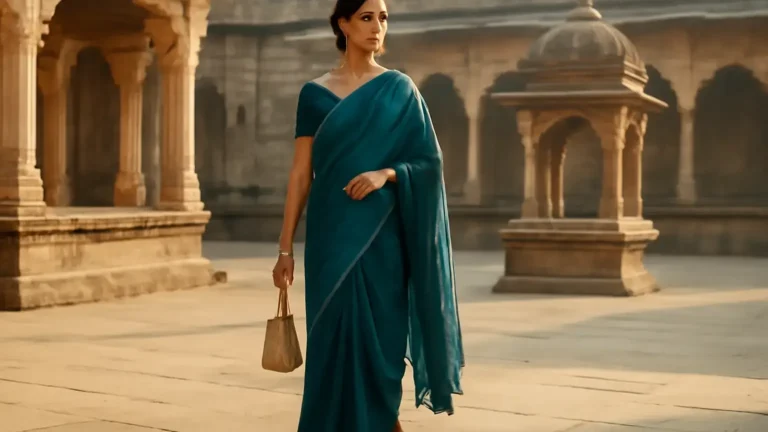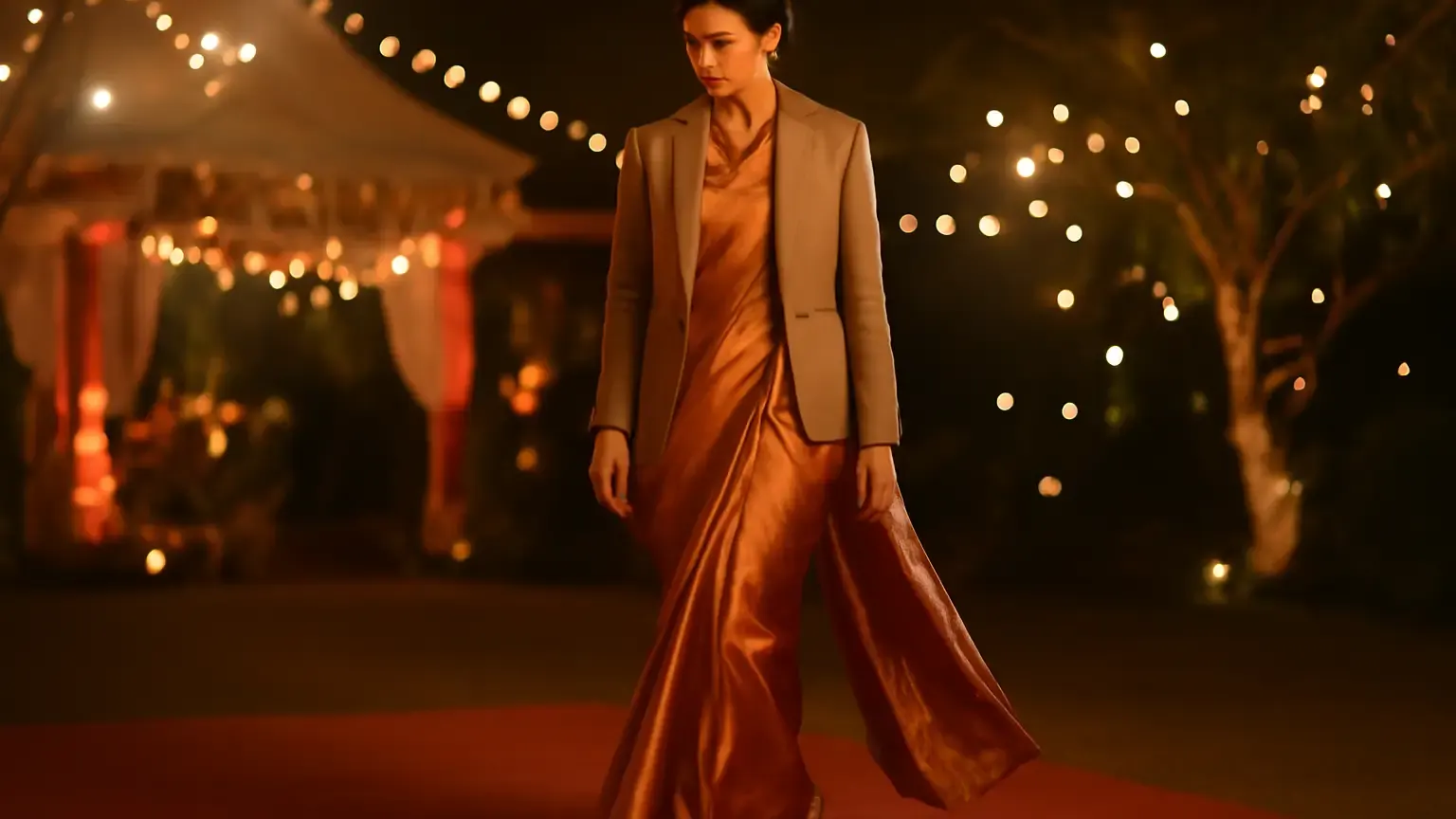
saree styling for winter weddings works best when warmth is added in thin, deliberate layers rather than one heavy wrap. This guide is for wedding guests and hosts dressing for cool Indian evenings who want polished saree looks for winter weddings without losing a clean waistline, graceful pleats or easy movement. Start with a warmer saree fabric, then balance a slim blouse layer, a practical wrap or jacket, covered footwear and jewellery that completes the proportion.
A winter wedding saree outfit has to solve two problems at once: it should look festive in photographs and remain comfortable when the temperature drops after sunset. The answer is not necessarily a thick shawl or a bulky sweater. Good styling distributes warmth across the outfit, so no single layer overwhelms the saree.
Think about the venue, the length of your commute, how much time you will spend outdoors and whether you will be seated for long periods. An open-air pheras ceremony needs more protection than a heated banquet hall. These six adjustments help you make that decision without sacrificing proportion.
1. Choose a saree fabric that naturally holds warmth
Fabric is the foundation of winter wedding saree styling. A saree with some body and a closer weave feels more protective than a very sheer, airy fabric, while still allowing the drape to move. Silk, raw silk, velvet accents, brocade, tussar and heavier satin are useful choices for cooler evenings. They also photograph well under warm venue lighting.
When comparing warm saree fabrics, consider both weight and breathability. A substantial silk may be comfortable through a long reception, whereas a densely layered synthetic fabric can feel clammy indoors. Banarasi-style weaves, silk blends and brocade borders add visual richness without requiring many extra layers.
- For an indoor reception: silk, satin or a medium-weight georgette with a lined blouse can be enough.
- For an outdoor ceremony: raw silk, brocade or a heavier silk blend gives better insulation.
- For petite frames: choose a fabric with structure but avoid an oversized border and a bulky wrap together.
- For fuller proportions: a fluid silk blend with a neat fall can offer warmth without adding unnecessary width.
2. Build warmth into the blouse
A blouse is the easiest place to add insulation because it sits close to the body and does not disturb the saree’s outer line. Full sleeves, a higher neckline and a properly lined bodice create a polished base. If you usually feel cold at the arms, a three-quarter or full-sleeve blouse is more useful than simply adding a decorative layer over the pallu.
Make saree blouse layering look intentional
For saree blouse layering, use a fine, close-fitting camisole or thermal inner layer underneath the blouse, provided it does not create visible bunching. Match the neckline and sleeve length carefully. A thermal blouse for saree dressing should be smooth, lightweight and tested with the exact blouse before the event; thick seams can show through fitted fabrics.
A velvet blouse, high-neck brocade blouse or long-sleeved silk blouse gives a winter-appropriate finish. If your saree is ornate, keep the blouse shape clean. If the saree is plain, texture on the blouse can supply the festive detail. Avoid adding a high neck, puff sleeves, heavy embroidery and a broad belt all at once, as these competing elements can make the upper body look crowded.
3. Use a shawl or dupatta as a controlled layer
A shawl can be both practical and elegant when it has a defined placement. The safest option is to drape it over both shoulders and secure it discreetly near the waist or under the pallu. This keeps your hands free and stops the wrap from sliding during greetings, dining or dancing.
How to wear a shawl with a saree
For a classic saree with shawl look, choose a fine wool, pashmina-style or silk-wool layer in a colour that connects with the border or blouse. A monochromatic wrap creates a long vertical line; a contrast shawl makes more of a statement and works best with a quieter saree.
Do not knot a thick shawl tightly across the bust, as this can flatten the saree’s drape and add visual width. Instead, let one side fall slightly longer and secure the inner edge with a small, discreet pin. Keep the pin away from delicate zari or sheer fabric. For an outdoor ceremony, carry the shawl folded in a small tote until needed rather than wearing it from the start.
4. Add a jacket or cape that respects the pleats
A jacket is useful when you want more coverage than a shawl but a sharper silhouette than a loose wrap. Longline jackets, cropped structured jackets and cape layers can all work, provided the length is chosen in relation to the saree’s border and pallu.
A saree with jacket is especially effective for receptions because it looks finished even when the jacket remains on throughout the evening. A cropped jacket highlights the waist and works with high-waisted pleats. A hip-length or longline jacket gives more protection and suits a simple saree with minimal embellishment. A cape creates softness, but it should not be so voluminous that it catches on chairs or hides the pallu.
For movement, check three details before leaving home:
- Raise both arms to confirm the armholes do not pull.
- Sit down to make sure the jacket hem does not bunch over the pleats.
- Walk up a few steps and turn once to check that the pallu stays clear.
5. Protect the feet without losing the festive finish
Cold floors and outdoor lawns can make an otherwise beautiful outfit uncomfortable. The right winter wedding footwear adds warmth at ground level and prevents the saree from dragging. Closed-toe pumps, embellished slingbacks, block heels and sleek ankle boots can all work, depending on the saree and venue.
For grass, gravel or uneven paths, choose a stable block heel or a dressy flat with a covered toe. For a formal indoor reception, pointed closed-toe heels create a longer line under the pleats. Ankle boots are best with a structured saree and a carefully measured hem; avoid pairing chunky outdoor boots with a very delicate chiffon drape unless the contrast is deliberately styled.
Wear the footwear during the final draping trial. Saree length changes with heel height, and a last-minute adjustment can make pleats too short or cause the pallu to brush the floor. Thin socks or smooth foot liners may add comfort, but check that they do not make the shoe tight.
6. Finish with jewellery that adds visual warmth
Jewellery cannot replace a coat, but it can make a winter outfit feel richer without adding physical bulk. Gold, antique gold, rose gold, pearls and warm-toned stones complement the deeper colours commonly chosen for evening weddings. The goal is to create glow around the face and neck while keeping the outer layer easy to manage.
With a high-neck or full-sleeve blouse, prioritise earrings, a maang tikka or a bracelet stack instead of forcing a heavy necklace into a crowded neckline. With a plain silk saree and a simple blouse, a strong necklace or layered pearls can provide the festive focus. Statement jewellery with saree works best when one area leads and the others support it.
Consider the practical side as well. Large bangles can catch on a shawl, long earrings may tangle in a jacket collar and a heavy necklace can become uncomfortable during a long ceremony. Choose secure backs, smooth finishes and pieces that allow you to adjust your outer layer easily.
How to balance all six elements
The most elegant saree draping tips for winter are about restraint. If the saree is heavily woven, use a clean blouse and a light wrap. If the blouse has velvet or brocade, select a simpler saree and modest jewellery. If you are wearing a jacket, let the pallu remain neat and avoid a large shawl unless the temperature genuinely requires it.
| Wedding setting | Best warmth combination | What to avoid |
|---|---|---|
| Indoor reception | Silk saree, lined full-sleeve blouse, closed-toe heels | Too many insulating layers indoors |
| Open-air pheras | Heavier saree, slim thermal base, shawl or long jacket, stable footwear | Loose hems and delicate shoes on grass |
| Daytime winter wedding | Medium-weight saree, structured blouse, light cape or cropped jacket | Dark heavy layers that feel visually dense |
| Long travel plus reception | Removable jacket, practical shoes for arrival, dressy pair for changing | Styling that cannot be adjusted as the temperature changes |
Common mistakes to avoid
- Using one oversized wrap: A very thick shawl can hide the waist and interfere with the pallu. Use a thinner layer or a structured jacket when possible.
- Ignoring the back of the outfit: Wedding photographs often capture the pallu and blouse back. Check that a jacket or shawl does not create a messy fold.
- Choosing warmth without movement: Test sitting, walking, lifting your arms and using your phone before committing to the final combination.
- Overmatching every element: The blouse, shawl, jacket and jewellery do not need to be identical. Repeating one colour or metal is usually enough.
- Forgetting indoor heat: Removable layers are more versatile than a look that is warm only outdoors and uncomfortable inside.
A simple getting-ready routine
Two days before the event, try the entire outfit with the planned footwear and outer layer. Mark the pallu position, check the saree length and sit for ten minutes. On the day, wear the base layer first, drape the saree firmly but comfortably, then add the jacket or shawl after jewellery and hair are complete. Keep a couple of safety pins, a small fashion tape strip and a compact wrap bag in your emergency kit.
The best saree styling for winter weddings feels considered rather than heavily layered. Choose warmth according to the venue, keep the closest layers slim and let one feature—fabric, jacket, shawl or jewellery—lead the look. That approach preserves proportion, movement and the celebratory character of the saree.
Products that may help with this routine
Choose only what fits your skin, hair or personal needs. Use the links below to view current options on Amazon India.
Frequently Asked Questions
How do you style a saree for a winter wedding?
Start with a medium- or heavy-weight saree, then add a lined full-sleeve blouse or thin thermal base. Finish with a removable shawl or structured jacket, closed-toe footwear and jewellery that does not interfere with the layers.
What are the best saree fabrics for winter weddings?
Silk, raw silk, brocade, tussar, velvet accents and medium-weight satin are useful choices for cooler evenings because they provide structure and warmth. Choose a lighter silk blend for heated indoor venues.
What should you wear over a saree for a winter wedding?
A fine shawl, longline jacket, cropped structured jacket or cape can work over a saree. Select the layer according to the venue and keep its volume controlled so the pleats and pallu remain visible.
How can you keep warm in a saree at a wedding?
Use a smooth thermal base under a full-sleeve blouse, choose a warmer saree fabric, protect your feet with closed-toe shoes and carry a removable shawl or jacket for outdoor portions of the event.
Can you wear a shawl with a saree?
Yes. Drape a fine shawl over one or both shoulders and secure the inner edge discreetly near the waist or beneath the pallu. Avoid tying a thick shawl tightly across the bust.
What is the best footwear for a winter wedding saree?
Closed-toe pumps, embellished slingbacks, stable block heels and sleek ankle boots can suit a winter saree. Choose the pair based on the surface, heel stability and final saree length.