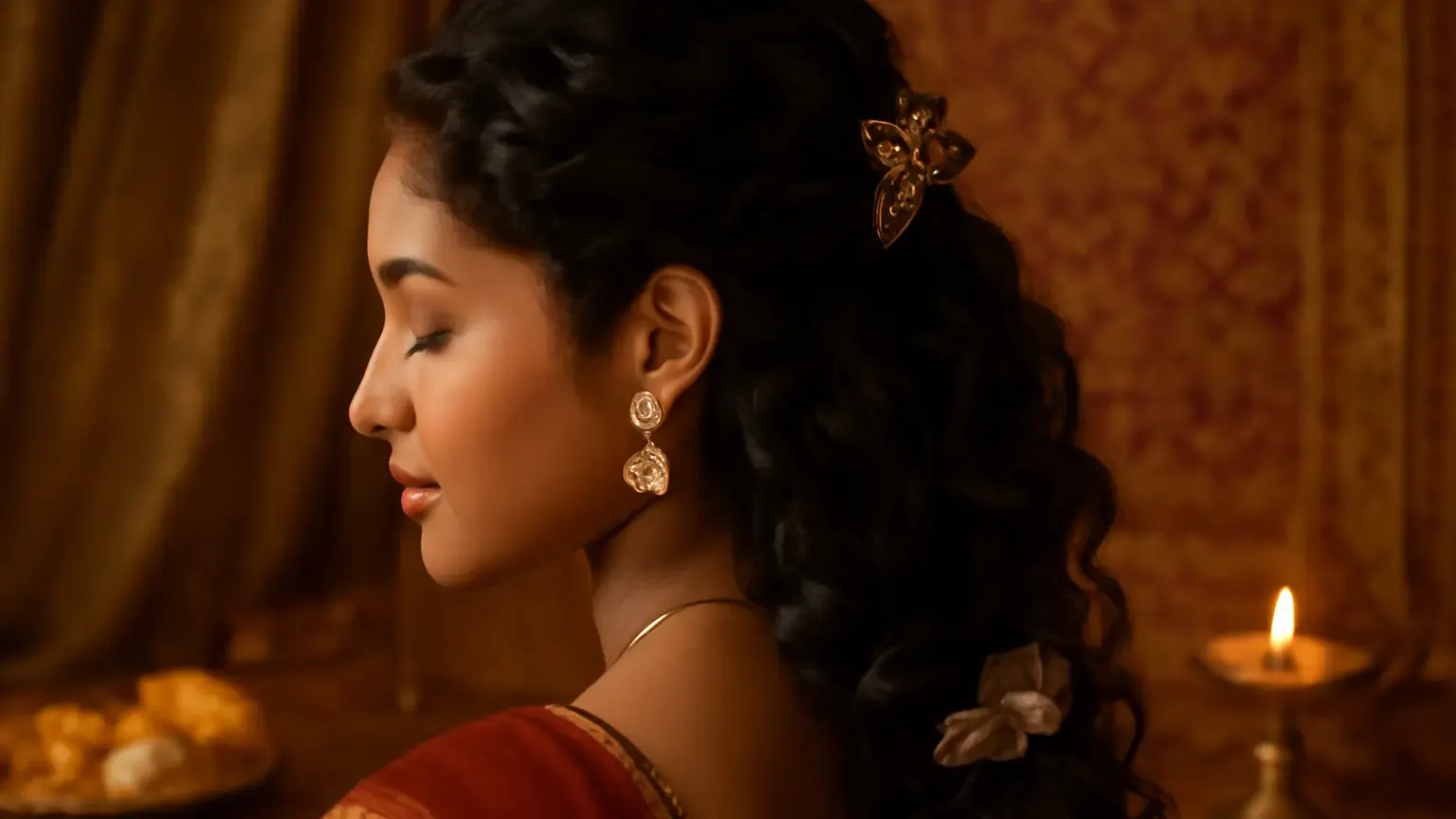
curly wavy hair and hair accessories work best when the accessory matches your hair’s density, curl pattern and the amount of hold you need. For festive styling, choose a claw clip or decorative barrette for a quick gathered look, pins for precise placement, and satin-covered soft ties for low-tension ponytails or buns. The right choice keeps curl definition intact, limits pulling and makes the style comfortable through a celebration.
Curly and wavy hair rarely needs more force; it needs better placement. An accessory that feels secure on straight hair can press down wave formation, catch individual curls or create a visible dent. Before choosing a pretty detail for a wedding, festival, family function or party, consider four things: how much hair you are gathering, where the accessory will sit, how long you will wear it and how much tension your scalp can comfortably tolerate.
How to choose hair accessories for curly wavy hair
Start with the style rather than the decoration. A half-up look needs a different tool from a high bun, and loose waves need less gripping force than dense curls.
- For a loose half-up style: use a medium barrette, small claw clip or a pair of gently placed pins. Keep the lower curls free so they are not compressed.
- For a full updo: choose a larger claw clip, wide U-pins or several small pins distributed across the shape instead of one tight tie.
- For a ponytail: a satin scrunchie or no-crease hair tie is usually more comfortable than a thin elastic.
- For fine waves: select lightweight hair accessories. Heavy metal or embellished pieces may pull the style down and encourage slippage.
- For thick or highly textured curls: look for broad teeth, a strong hinge and enough opening capacity. A tiny clip can pinch rather than hold.
The most useful test is simple: after securing the hair, you should be able to slide one fingertip under the tie or feel only light, even pressure from a clip. Sharp pressure at one point is a sign to reposition the accessory.
Clips: fast hold with less wrapping
Clips are convenient for curls because they can gather hair without repeated twisting. They also make it easy to create a festive shape while leaving some texture visible.
Claw clips for thick hair
Claw clips for thick hair should open wide enough to contain the section without forcing you to flatten it first. A larger clip with rounded teeth can support a French twist, a low twist or a half-up section. Place it around the gathered hair, not directly against the scalp, and allow a little volume at the crown.
To use a claw clip without ruining curls, gather the hair with open palms rather than brushing it tightly. Twist only as much as needed, anchor the clip into the twist and gently pull out a few curls around the face. If the clip feels heavy, move it lower or choose a smaller section.
For looser waves, a clip with a broad surface may be kinder than narrow teeth. Narrow teeth can leave lines, particularly when the hair is damp or freshly styled.
Barrettes and snap clips
Barrettes are useful for controlling a side section or securing a half-up look. Place them over a flat, small section rather than forcing a large curl bundle underneath. Snap clips can hold flyaways, but use them on the surface and avoid dragging them through the hair. Look for smooth edges and check the hinge for snagging points before wearing them for several hours.
Pins: precision without a tight elastic
Bobby pins for curly hair are helpful when you want an updo to look softly arranged rather than tightly pulled. They can secure a bun, hold a pinned-back side or support decorative flowers and jewels. However, pins work through placement, not sheer quantity.
Open the pin only slightly, slide the wavy side towards the scalp and catch a small amount of the style. Insert it at an angle into the base, then cross a second pin over it if more stability is needed. This distributes hold and reduces the need to push one pin hard against the scalp.
Are bobby pins safe for curly hair? Generally, they can be used safely when they have smooth coated tips, are inserted without scraping and are removed by opening them rather than pulling them through. Do not sleep in rigid pins or keep adjusting them if they create soreness. For dense hair, U-pins can sometimes secure a bun with fewer points of pressure than multiple tight bobby pins.
Check decorative pins carefully. Beads, wire ends and rough plating may catch curl clumps. If the embellishment is heavy, place it into a supported bun or twist rather than a fragile loose curl.
Soft ties, scrunchies and bands: the low-tension choice
Soft ties are often the most comfortable option for a ponytail, pineapple or relaxed bun. Satin scrunchies glide over the outer layer and spread pressure over a wider area. They are especially useful when you want to reduce frizz in curls caused by repeated tying and untying.
No-crease hair ties can help preserve the shape of waves, but “no crease” is not a guarantee for every curl pattern. Any band may leave a mark if it is wrapped too tightly or left in one position for hours. Choose the loosest hold that keeps the style together and vary the placement during a long event.
Scalp-friendly hair ties should feel covered, flexible and free from rough seams. Avoid thin rubber bands, exposed metal joins and ties that require many tight wraps. For a low ponytail, secure the hair near the nape. For a high style, first create a loose base with your hands, then use the tie once or twice rather than repeatedly tightening it.
Which accessory helps preserve curl definition?
Curl definition depends on the condition and styling routine as well as the accessory. Apply your usual leave-in or styling product, allow the hair to set as directed and handle it only when it is mostly dry. Pulling a wet curl into a tight tie can stretch its shape and create uneven drying.
Protective styling for waves does not have to mean a completely covered style. A loose side sweep, low bun or half-up clip can reduce rubbing while keeping the lengths visible. For tighter curls, a pineapple secured with a soft tie can protect the crown overnight, provided the tie is loose and the curls are not compressed at the front.
For a festive event, a practical sequence is:
- Detangle gently with fingers or a suitable wide-tooth tool, starting at the ends.
- Refresh only areas that need definition; avoid soaking the entire style if you are short on drying time.
- Choose the accessory according to the weight of the gathered section.
- Secure the base first, then add the decorative piece. This prevents embellishment from carrying all the tension.
- After 10 minutes, check for pinching, scalp pulling, slipping or a developing crease.
How to reduce frizz and hair breakage during festive styling
Frizz often appears when the cuticle is disturbed by friction, humidity or repeated handling. Hair breakage is more likely when the same section is pulled tightly, especially if the hair is dry, fragile or already snagged. Accessories cannot remove these risks, but thoughtful use can lower them.
- Gather hair with flat palms instead of brushing curls into a compact mass.
- Use a satin or smooth fabric tie for ponytails and buns.
- Do not force a clip through a knot; release the section and separate it first.
- Keep decorative pieces light and secure them to the strongest part of the style.
- Remove accessories slowly at the end of the event. Unwrap ties and open clips fully before sliding them out.
- Carry one spare soft tie rather than repeatedly tightening a slipping accessory.
If an accessory causes persistent scalp tenderness, visible thinning at a repeated tension point or unusual shedding, stop using that style and seek advice from a dermatologist or doctor, particularly if the concern continues.
Quick comparison: clips, pins, bands or soft ties?
| Accessory | Best use | Hold | Main caution |
|---|---|---|---|
| Claw clip | Half-up styles, twists and quick updos | Medium to strong | Can be heavy or leave dents if oversized |
| Barrette or snap clip | Side sections and polished half-up looks | Light to medium | Rough edges may snag curls |
| Bobby pin or U-pin | Precise placement and bun support | Targeted | Too many pins can create pressure |
| Soft tie or satin scrunchie | Ponytails, loose buns and pineapple styles | Light to medium | Too much wrapping can still crease or pull |
| Decorative band | Finishing a low ponytail or headband look | Light | Check grip, seams and pressure behind the ears |
The best choice for your festive look
Choose a clip when you want speed and adjustable volume, pins when you need discreet precision, and a soft tie when comfort and low tension matter most. A polished result does not require every curl to be fixed in place. Leave room for movement, distribute the hold and place decoration on a stable base.
In short, the best curly wavy hair and hair accessories combination is the one that supports the style without flattening its texture: broad clips for gathered volume, smooth pins for detail and satin-covered ties for gentle restraint. Test the accessory in a short trial run before the celebration so you can identify pressure, slipping or frizz before you leave home.
Products that may help with this routine
Choose only what fits your skin, hair or personal needs. Use the links below to view current options on Amazon India.
Frequently Asked Questions
What are the best hair accessories for curly wavy hair for weddings?
For weddings, choose a lightweight claw clip or barrette for a half-up style, smooth bobby or U-pins for an updo, and a satin scrunchie for a low ponytail or bun. Match the accessory to your hair density and secure decoration to a supported base rather than a loose curl.
How do you use claw clips without ruining curls?
Gather the hair with your hands, avoid brushing it flat, twist only as much as needed and place the claw clip around the gathered section. Use a size that holds the hair without squeezing it, and reposition the clip if it creates a dent or scalp pressure.
Which hair ties reduce frizz in curly hair?
Satin-covered scrunchies and smooth, seamless no-crease ties generally create less friction than thin rubber bands or ties with exposed metal. Keep the hold loose, avoid repeated tightening and remove the tie by unwinding it rather than pulling it through the curls.
Are bobby pins safe for curly hair?
Bobby pins can be safe when they have smooth tips, are placed without scraping and are removed by opening them first. Use only as many as needed, avoid sleeping in them and stop if a pin causes soreness or catches individual curls.
What are easy festive hairstyles for curly wavy hair with accessories?
Try a half-up style with a barrette, a low twisted bun held with U-pins, a side sweep with two smooth pins or a loose ponytail finished with a satin scrunchie. Keep the base relaxed so the curls retain movement and volume.
How can you prevent hair breakage from hair accessories?
Choose smooth, lightweight accessories, avoid tight repeated wrapping, distribute pins across the style and never force a clip through a knot. Remove accessories slowly and change the placement of ties during long wear.


