How to choose foundation shade becomes much easier when you treat it as a five-check decision rather than a quick wrist swatch. This guide is for Indian shoppers navigating yellow, golden, olive, pink and neutral undertones, as well as uneven facial pigmentation. Before buying, identify your undertone, match depth to your neck, compare the shade in indoor and natural light, check for oxidation, and make sure the finish and coverage suit your skin and routine.
Foundation should make the complexion look more even without creating a visible border between the face and neck. In India, shade selection can be challenging because skin depth varies widely, undertones may be golden, olive, neutral or pink, and the face may be darker or more pigmented than the neck. A shade that looks correct under a shop’s bright lights may appear orange, grey or too pale outdoors.
The safest approach is to separate two decisions: colour match and formula suitability. Colour match means finding the right undertone and foundation depth. Formula suitability means choosing a foundation finish and coverage level that work with your skin’s texture, climate and makeup routine. Use the five checks below before purchasing, whether you are shopping in a store or choosing a shade online in India.
1. Identify your undertone before judging the shade
Your undertone is the subtle colour beneath the surface of your skin. It remains relatively consistent even when your skin becomes more tanned. Foundation depth describes how light or deep your complexion appears; undertone describes whether that depth leans warm, cool, neutral or olive. Both matter.
Simple undertone clues
- Warm undertone: Skin may appear golden, yellow or peach. Gold jewellery may feel especially harmonious, although jewellery is not a definitive test.
- Cool undertone: Skin may show pink, red or bluish hints. Silver jewellery may look flattering, but redness from sensitivity or sun exposure should not be mistaken for a cool undertone.
- Neutral undertone: The skin may sit between yellow and pink, without a strong pull in either direction.
- Olive undertone: The complexion can have a muted green, beige or slightly grey-golden cast. Olive skin is often incorrectly matched with very yellow or very pink formulas.
An undertone test is only a starting point. Veins, jewellery and white-versus-cream fabric can give clues, but the most reliable practical test is still a face or jawline swatch viewed after the formula settles. Indian skin tones do not fit one universal undertone category, so avoid choosing a shade solely because a label says “Indian” or “Asian.”
2. Match foundation depth to your neck, not your hand
For a natural result, the foundation depth should blend into the area where the face meets the neck. This is the principle behind neck matching. Hands are useful for checking texture, but they are often more tanned, more exposed to sunlight or a different depth from the face.
How to perform a jawline swatch
- Start with clean skin and avoid applying several shades over skincare, sunscreen or existing makeup.
- Choose two or three shades that appear close to your complexion. Include one slightly lighter or deeper option if you are uncertain.
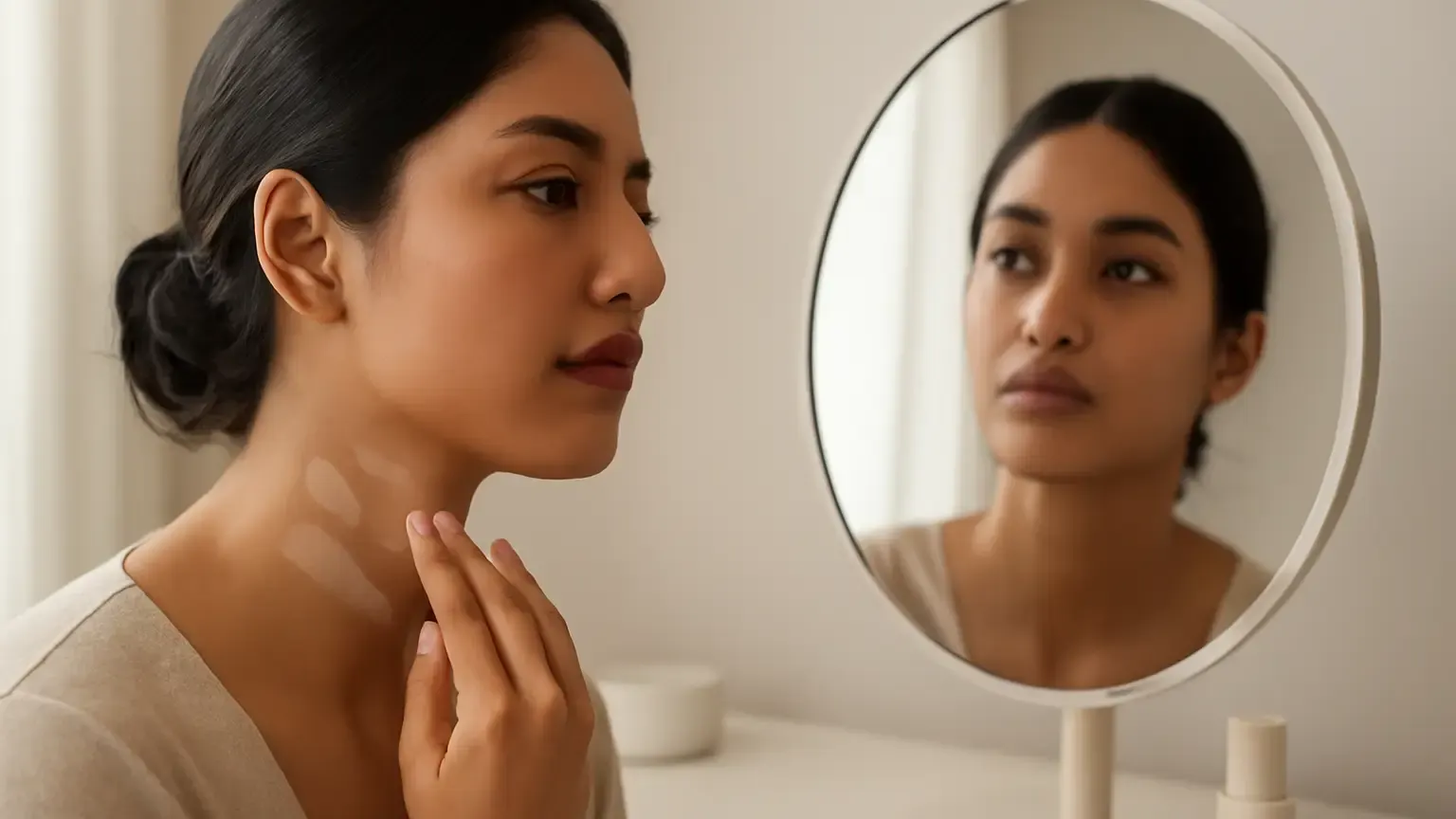
- Apply narrow vertical stripes from the lower cheek across the jawline and slightly onto the neck.
- Let the stripes sit for a few minutes. Do not judge only while the product is wet.
- Choose the shade that visually disappears across the jawline. If the face and neck are noticeably different depths, prioritise a balanced match rather than making the face look artificially pale or dark.
When the face has more pigmentation, blemishes or a tan than the neck, a perfectly invisible match may not be possible. In that situation, select the shade that best harmonises with the jaw and upper neck, then use concealer or a small amount of colour correction only where extra evening is needed. Do not choose a foundation several shades lighter to cover pigmentation; it can create a flat, ashy appearance.
3. Compare the shade under indoor lighting and natural daylight
Lighting changes how foundation colour appears. Warm indoor bulbs can make a base look more yellow or deeper, while cool white lights can make it look pink, grey or pale. Natural daylight makeup checks are therefore important, especially when testing in a store.
After applying your swatches, inspect them in the shop’s indoor lighting first, then move near a window or step outdoors into indirect daylight. Avoid harsh direct sunlight, which can exaggerate texture and colour contrast. Look at the shade from a normal conversation distance, not only inches from a mirror.
Ask yourself three questions:
- Does the stripe look orange, pink, grey or noticeably yellow compared with the neck?
- Does it disappear when you turn your head, or is there a clear stripe at the jaw?
- Does the colour still look balanced in both indoor lighting and daylight?
If a shade looks right indoors but too orange outside, it may have the wrong undertone or may deepen as it dries. If it looks perfect in daylight but very pale under indoor lighting, check whether the light is unusually warm before rejecting it. When buying online, compare the brand’s shade descriptions, swatches on different skin depths and return policy, but remember that screen settings and photography can distort colour.
4. Do an oxidation test before you commit
Oxidation is the gradual darkening or colour shift that can happen as foundation dries and interacts with air, skincare, sunscreen, sweat and natural skin oils. Not every formula oxidises noticeably, and the change can vary by person. A shade that initially looks correct may later appear deeper, warmer or more orange.
A practical oxidation test
- Apply one or two likely shades along the jawline rather than the wrist.
- Leave the swatches untouched for at least 15 to 20 minutes, or follow the product’s recommended setting time.
- Continue with a normal store visit or walk around at home if you have a sample.
- Compare the dried swatches with the neck in both indoor lighting and daylight.
If a formula consistently deepens, do not automatically buy a much lighter shade. A very pale base can turn grey or chalky once blended. Instead, look for a closer undertone match, allow for the formula’s final colour, and test it over the skincare and sunscreen you normally wear. If purchasing online, a sample or a retailer with exchanges is more useful than guessing from a shade name alone.
5. Check the foundation finish and coverage level
A colour match can still look wrong if the formula does not suit your skin or the occasion. Finish refers to how the base looks once set: matte, natural, satin, radiant or dewy. Coverage level refers to how much discolouration the product hides, from sheer to full.
- Dry or dehydrated-feeling skin: A comfortable natural or satin finish may look more even than a very matte base. Apply moisturiser and allow it to settle before testing.
- Oily or combination skin: A natural-matte or soft-matte formula may be easier to manage, but heavy layers can still separate in heat and humidity.
- Uneven pigmentation: Medium coverage can be more practical than applying a thick full-coverage layer everywhere. Spot-conceal only where needed.
- Everyday makeup: Sheer or buildable coverage often gives a more forgiving result when the shade is close but not absolutely perfect.
Skin preparation also affects colour perception. A dry patch can make foundation look lighter and uneven, while excess oil can make it appear darker or more orange. Test the product over your usual daytime routine instead of judging a bare-skin swatch only.
Common foundation shade-matching mistakes
- Testing on the wrist: The wrist is convenient but rarely matches the face and neck closely enough.
- Choosing the lightest shade: A lighter base does not automatically make skin look brighter; an undertone mismatch can make it look ashy.
- Ignoring olive undertones: A green-beige cast may need a muted or olive-friendly option rather than a strongly yellow shade.
- Judging immediately: Wet foundation can look different after blending and settling.
- Testing one thick patch: A heavy patch hides how the product looks in a normal thin layer.
- Matching only the centre of the face: The forehead, cheeks and jaw can vary in depth, so assess the transition to the neck.
- Skipping the return policy: Online shade matching involves uncertainty. Check whether opened beauty products can be exchanged before buying.
A quick pre-purchase checklist
Before paying, confirm that you have:
- Identified your likely undertone without relying on a single vein or jewellery test.
- Compared at least two nearby shades on the jawline and upper neck.
- Checked the swatches in indoor lighting and indirect natural daylight.
- Allowed enough time to notice a possible colour change or oxidation.
- Chosen a finish and coverage level that suit your skin, climate and regular makeup routine.
Takeaway: To know how to choose foundation shade, first find the undertone, then match foundation depth to the neck, test a thin jawline swatch in more than one light, wait for oxidation, and assess the formula’s finish and coverage. This five-check method is more dependable than choosing by wrist colour, shade name or shop lighting alone.
Products that may help with this routine
Choose only what fits your skin, hair or personal needs. Use the links below to view current options on Amazon India.
Frequently Asked Questions
How to choose foundation shade for Indian skin?
Identify whether your undertone is warm, cool, neutral or olive, then test two or three close shades along the jawline and upper neck. Check the swatches indoors and in indirect natural daylight, wait for possible oxidation, and choose the shade that blends into the neck without looking orange, grey or pale.
How to match foundation shade to neck?
Apply thin vertical swatches from the lower cheek across the jaw and slightly onto the neck. The best match is the shade that visually disappears across this transition after it has settled. Avoid using the wrist as your main matching area.
What undertone is common in Indian skin?
Many Indian complexions have warm, golden or neutral undertones, but there is no single undertone shared by everyone. Cool, olive and combination undertones are also possible, so a jawline test is more reliable than assuming based on ethnicity.
How to test foundation oxidation before buying?
Apply a thin jawline swatch and leave it for about 15 to 20 minutes, or follow the product’s setting time. Compare it with your neck in indoor lighting and indirect daylight. If it becomes noticeably darker or more orange, test another shade or formula.
What is the best way to test foundation in natural daylight?
After applying thin jawline swatches, view them near a window or outdoors in indirect daylight. Avoid harsh direct sun, and compare the swatches from a normal distance with the face and neck rather than inspecting only a close-up mirror view.
How can I choose foundation shade online in India?
Use the brand’s shade descriptions, undertone labels, swatches across multiple Indian skin depths and any virtual shade tool as starting points. Check the exchange policy, order samples when available, and compare the final shade after it settles rather than trusting a screen image alone.