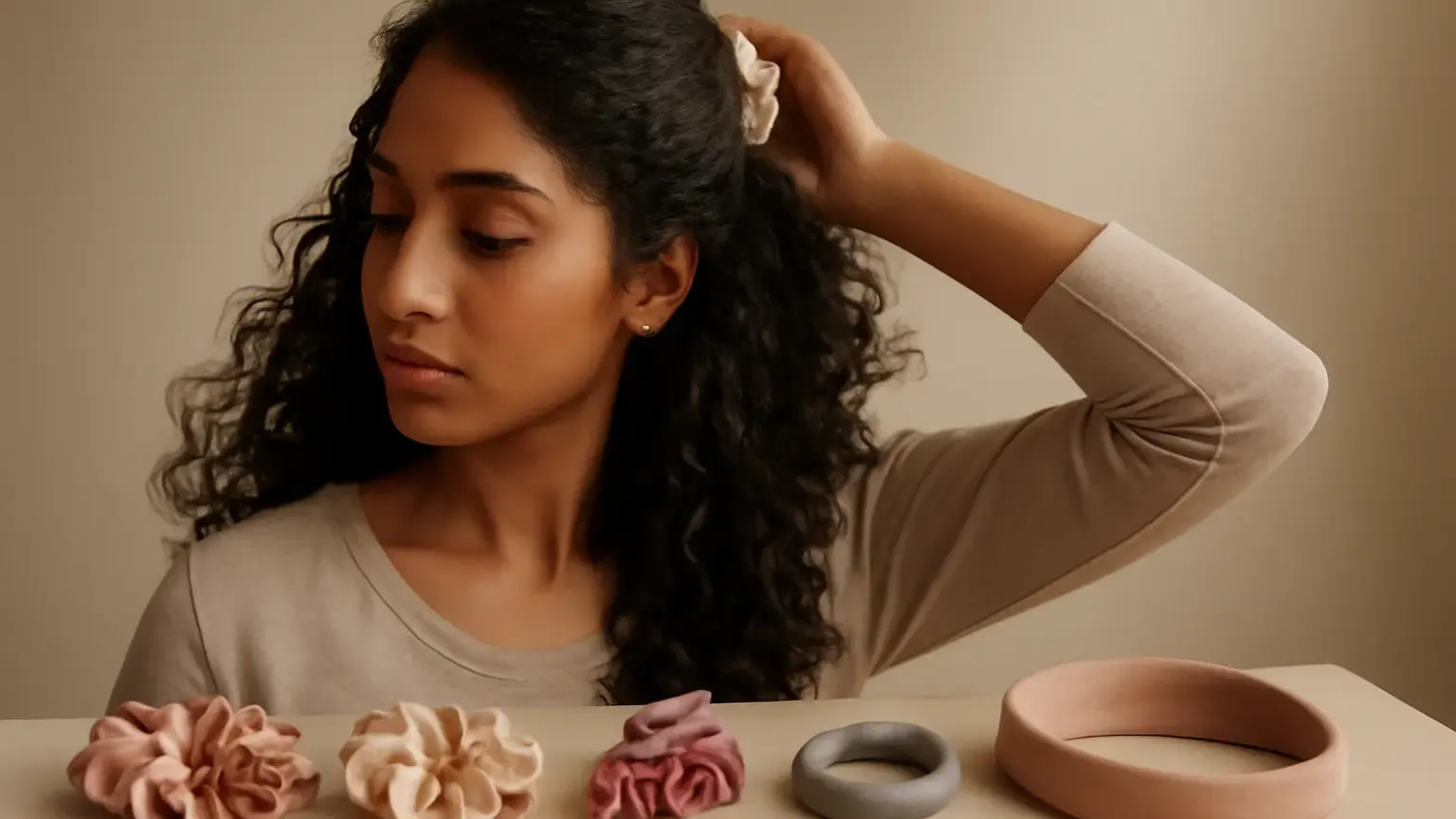
Curly wavy hair and hair accessories work best when the accessory matches your curl pattern, density and styling goal. Choose a smooth scrunchie or loose claw clip for volume, a fabric-covered tie for controlled hold, and a wide soft headband for keeping hair away from the face. This guide is for anyone with curls, waves or mixed texture who wants reliable hold without flattening definition, pulling at roots or creating a painful removal session.
The right accessory should support the shape your hair already has, not force it into a tight style. Curly and wavy hair often has more surface friction, bends and fragile areas than straight hair, so a narrow elastic or rough seam can catch strands quickly. The best choice depends on whether you need a loose updo, a secure ponytail, face-framing control or a way to protect a finished style overnight.
Start with the accessory’s job
Before choosing from the many hair accessories for curly hair and hair accessories for wavy hair, decide what you want the accessory to do. A product that is excellent for a wash-day pineapple may be unsuitable for a neat workout ponytail.
- Preserve volume: Pick a large claw clip, loose scrunchie or soft spiral tie. These spread pressure over a wider area rather than creating one tight pinch.
- Control the front: Choose a wide fabric headband, padded barrette or smooth clip with rounded edges.
- Secure a dense updo: Use a strong, wide-jawed clip or a fabric-covered elastic, but avoid repeatedly wrapping it until the roots feel tight.
- Protect a finished style overnight: A loose satin scrunchie or high, soft pineapple can reduce compression at the crown.
- Hold fine waves: Select lightweight accessories that do not drag the hair down. This is especially useful for fine wavy hair styling.
If the accessory leaves a deep line, causes scalp discomfort or makes detangling difficult, it is too tight, too small or poorly suited to that section of hair.
Compare shapes: scrunchies, ties, clips and headbands
Scrunchies for soft, low-tension hold
Curly hair scrunchies are usually a reliable starting point because their fabric covering creates a broader contact area. They are useful for loose ponytails, buns and overnight styles. Satin or silk-covered options tend to glide more easily than textured cotton, although the elastic inside still matters. A very stretched or exposed inner band can snag just as much as an uncovered hair tie.
Silk scrunchies and satin alternatives are particularly useful when you want less friction during removal. Silk is a natural fibre, while satin describes a type of smooth weave and may be made from different fibres. The label alone does not guarantee gentle performance: check that the stitching is tidy and that no elastic is exposed.
Claw clips for volume and quick styling
Claw clips for curls can hold a twist or half-up style without compressing the entire length. Look for rounded teeth, a spring that opens smoothly and enough jaw width to hold your density without forcing a thick bundle through a small opening. A clip that is too small may create pressure at one point and slip, encouraging you to tighten it repeatedly.
Large clips can be excellent for dense curls, but fine waves may need a smaller, lighter version. Place the clip around the gathered hair rather than scraping every strand into a rigid twist. Leaving some natural looseness helps retain volume and reduces the chance of a harsh crease.
Hair ties for a more secure ponytail
No-snag hair ties are generally fabric-covered, smoothly finished and free from exposed metal joins. They are useful for exercise, commuting or any activity where a clip could catch on clothing. A wide, soft tie is often more comfortable than a thin elastic, but it should still be wrapped only as much as needed.
Hair-friendly elastics are not automatically harmless. Repeated tight tension can stress the same area, especially at the hairline or where the ponytail rubs against a collar. For daily use, vary the height of the ponytail and change the placement rather than securing it in exactly the same spot every day.
Headbands for front-hair control
Headbands for wavy hair work well when you need to keep hair away from your face without gathering the full length. Choose a wide band with a soft inner surface and enough stretch to stay in place without pressing behind the ears. A narrow, rigid band can create a visible dent and may encourage frizz where it rubs against the temples.
For curly textures, position the band over the hair rather than sliding it aggressively from the forehead to the crown. If the band has teeth, inspect them for sharp edges and avoid dragging it through dry, tightly coiled sections.
Choose materials that reduce friction
Material affects how easily an accessory moves across the hair. Smooth satin hair accessories can reduce surface drag, particularly during removal. Velvet and soft fabric may offer useful grip, but a rough weave can catch more easily in dry or tightly curled strands. Plastic and resin clips should have polished edges; any visible seam or sharp mould line is a warning sign.
Metal components deserve attention too. A metal join, barrette clasp or exposed spring can catch curls and create a small but damaging snag. Look for covered fasteners, rounded ends and closures that open fully rather than requiring you to pull the hair away from them.
Hair porosity also changes how an accessory feels. High-porosity curls may feel drier and catch more readily, so smooth fabrics and low-friction removal are valuable. Hair that is freshly conditioned may have more slip, but do not rely on conditioner to compensate for a rough accessory.
Match the accessory to your curl pattern and density
Loose waves often lose shape when weighed down. A light clip or narrow fabric-covered tie may be enough, while a heavy oversized claw clip can pull the crown flat. For tighter curls, a wide-jawed clip or larger scrunchie usually distributes pressure better than a tiny accessory that compresses a small section.
Density matters as much as pattern. Thick hair needs a closure that can hold the bundle without excessive wrapping. Fine hair needs an accessory that grips without creating a tight point. Mixed textures may need two solutions: a soft clip for the curlier back sections and a small smooth barrette for shorter front pieces.
Consider the style’s direction, too. A low ponytail puts less upward tension on the hairline than a high, tight one. A loose pineapple protects height at the crown, while a low bun may preserve the front but flatten the back. The best volume-preserving hair accessories support the shape with minimal pressure.
How to put accessories in without disturbing definition
- Let the hair settle. If your curls or waves are freshly styled, wait until the product has set enough to resist immediate stretching.
- Gather with your hands first. Avoid brushing a finished curl pattern into a tight bundle. Use your fingertips or a wide-tooth comb only where necessary.
- Use the fewest wraps possible. Stop when the accessory holds. Extra tension rarely improves the look for long.
- Place pressure on stronger sections. A low ponytail or loose mid-height style can be more comfortable than pulling delicate baby hairs or the hairline.
- Check movement. Turn your head and gently lift the accessory. If it pulls, pinches or slips, change the size or position rather than tightening immediately.
For a half-up style, collect only the amount needed and allow the lower layers to remain free. For a bun, twist loosely and tuck the ends rather than winding the hair tightly around a small elastic. These simple adjustments can make an accessory feel more secure without sacrificing shape.
Remove accessories safely and refresh the style
Removal is where many snags happen. Do not pull a tied bundle straight through a knot or yank a claw clip open while it is still gripping multiple strands. First, support the hair near the accessory with one hand. Open the closure fully, then ease it away in the same direction the hair was gathered.
For scrunchies, unwind each loop instead of dragging the entire accessory over the ends. If a tie has caught, pause and separate the surrounding strands with your fingers. A small amount of water or leave-in conditioner can add slip for detangling curly hair, but avoid forcing the knot apart.
After removal, gently shake the roots and reshape individual curls or waves with damp fingers. If the accessory has left a crease, lightly mist that section and scrunch it rather than brushing through the whole style. Persistent pain, tenderness, visible breakage or scalp irritation is a reason to stop using the offending accessory and seek advice from a dermatologist or doctor if symptoms continue.
Common mistakes to avoid
- Using a tiny clip on dense hair: It concentrates pressure and is more likely to slip or catch.
- Choosing the tightest hold: Secure does not have to mean painful. Excess tension can flatten curls and stress the hairline.
- Sleeping in a rigid accessory: Hard clips and narrow bands may press into the scalp or rub against strands overnight.
- Ignoring worn fabric: Frayed seams and exposed elastic are common snag points. Replace accessories when their covering splits.
- Pulling through dry tangles: Add slip and separate the area gradually instead of treating the accessory like a brush.
- Repeating one placement: Rotate the location and style to reduce friction in one section.
A simple buying checklist
Before adding an accessory to your routine, check five details: the size of the opening, the smoothness of every edge, the amount of tension required, the weight of the piece and the ease of removal. For daily wear, prioritise comfort and smooth construction over decorative detail. For occasional styling, a stronger closure may be worthwhile, provided it does not require aggressive pulling.
In practical terms, choose a soft scrunchie for low-tension gathering, a rounded claw clip for quick volume, a covered elastic for active days and a wide fabric headband for face-framing control. Keep a lighter option for fine waves and a wider option for dense curls. This small rotation is more useful than relying on one accessory for every style.
Takeaway: match hold to the hair, not the other way around
The best curly wavy hair and hair accessories combination balances shape, comfort and easy removal. Smooth materials, rounded closures, wider contact areas and moderate tension help preserve definition while reducing snags. Choose the lightest accessory that can do the job, vary its placement and remove it slowly. When an accessory leaves a crease, causes pulling or catches during removal, treat that as useful feedback and switch its shape, size or material.
Products that may help with this routine
Choose only what fits your skin, hair or personal needs. Use the links below to view current options on Amazon India.
Frequently Asked Questions
What are the best hair accessories for curly wavy hair?
For most curls and waves, the best starting options are smooth scrunchies, rounded claw clips, fabric-covered hair ties and wide soft headbands. Choose based on density and purpose: clips for volume, scrunchies for loose gathering, covered ties for secure ponytails and headbands for front-hair control.
Are claw clips good for curly hair?
Yes, a claw clip can be good for curly hair when it has rounded teeth, a smooth finish and enough jaw width for the hair’s density. Use a larger clip for thick curls and a lighter, smaller clip for fine waves. Avoid forcing a large bundle into a narrow clip.
Which hair ties are least damaging for wavy hair?
Fabric-covered, smooth hair ties without exposed metal or rough seams are generally a gentler choice for wavy hair. Satin or silk-covered scrunchies can reduce friction, but any tie can create tension if it is wrapped too tightly or used in the same position every day.
How do you remove hair accessories from curls without frizz?
Support the hair near the accessory, open the closure fully and unwind each loop slowly. Do not drag a tie over a knot or pull a clip away while it is still gripping strands. If needed, use slightly damp fingers or a little leave-in conditioner to add slip before separating tangles.
What are the best scrunchies for fine wavy hair?
Fine wavy hair usually benefits from a lightweight, small-to-medium scrunchie with a smooth satin or silk-like covering and gentle elastic. It should hold a loose ponytail without requiring multiple tight wraps. Oversized or heavy scrunchies may pull the waves down.
How can you wear a headband without flattening curls?
Choose a wide, soft, flexible headband and place it gently over the styled hair rather than dragging it through the curls. Keep the fit comfortable around the temples and avoid narrow bands that create a deep crease. After removing it, shake the roots and reshape with damp fingers.