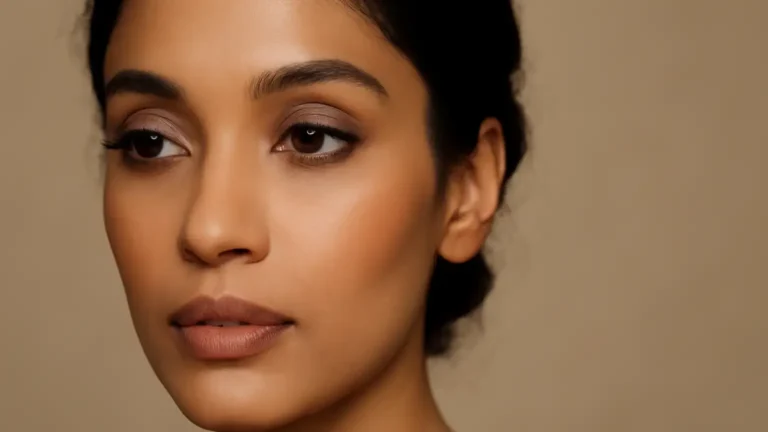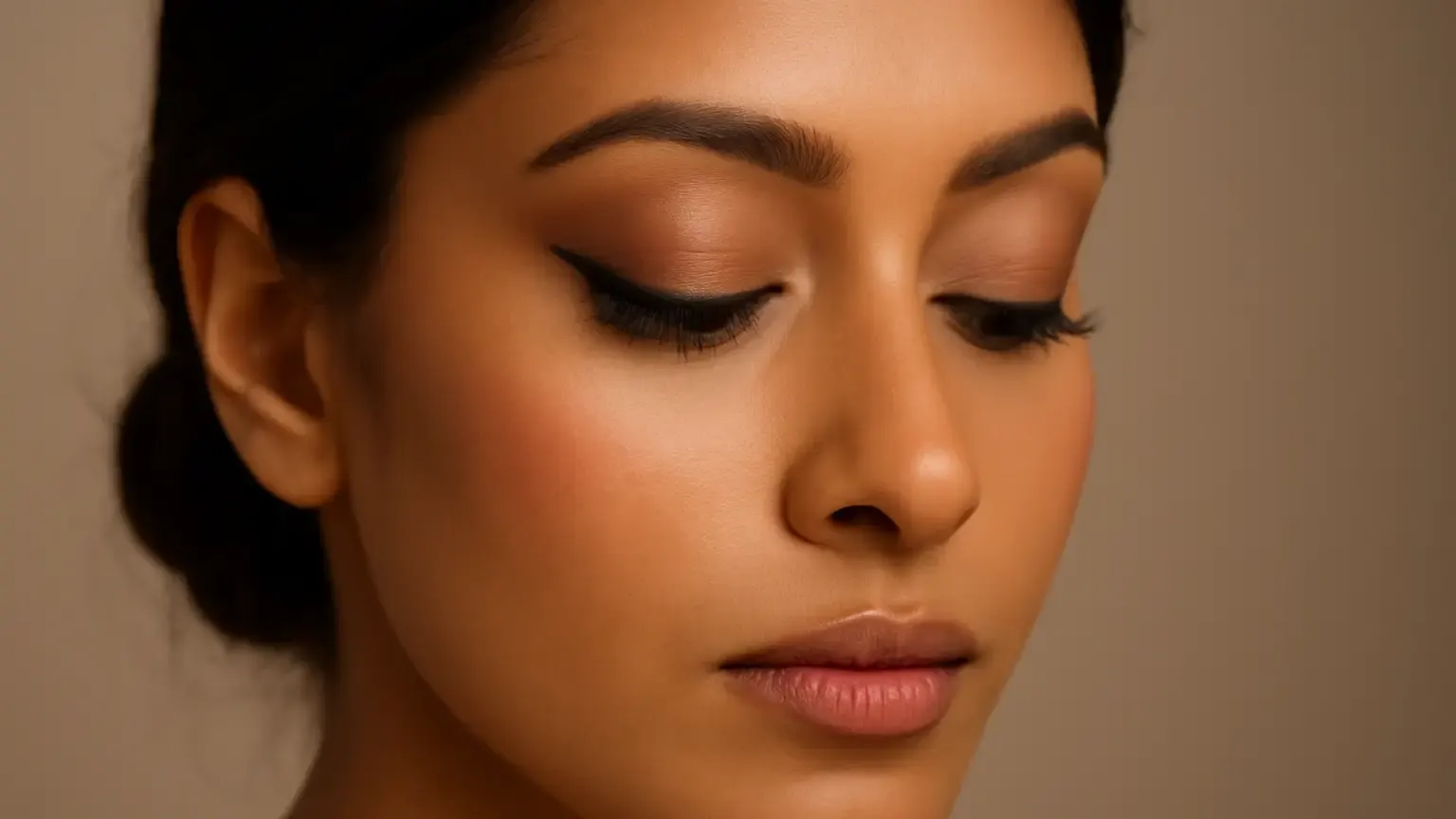
Eye Makeup for Downturned Eyes works best when colour and lines travel slightly upward from the natural outer corner. This guide is for anyone whose outer corners sit lower than the inner corners, including beginners looking for downturned eyes makeup India. You will learn where to place shadow, how to stop liner from dragging the eyes down, how to use lashes strategically and how to balance the lower lash line without losing definition.
Downturned eyes are an eye shape in which the outer corner sits a little lower than the inner corner. The shape can be subtle or more pronounced, and it may appear alongside hooded lids, deep-set eyes or mature skin. It is not a flaw to correct; the aim is simply to control visual direction so the finished makeup looks lifted, open and balanced.
Start by mapping your natural eye shape
Before applying product, look straight into a mirror with your eyes relaxed. Identify three points: the inner corner, the centre of the pupil and the outer corner. Imagine a line from the inner corner through the centre of the eye. If the outer corner falls below that line, your eyes are likely downturned.
This quick check matters because many standard tutorials use the outer corner as the endpoint for every product. On a downturned eye, following that point with dark pigment can make the eye look heavier at the side. Instead, keep the visual focus slightly above the natural corner while leaving enough of the real eye shape visible to avoid a painted-on effect.
For everyday lifted eye makeup, choose a soft transition shade close to your skin’s depth, a medium matte eyeshadow for structure and one deeper shade for controlled definition. Matte formulas are particularly useful in the crease because they create shape without adding reflective bulk to a folding lid.
Use an upward shadow direction
Build the crease above the natural dip
Apply a light transition shade through the crease, starting near the inner crease and blending towards the temple rather than directly towards the ear. Keep the outer end of the blend a few millimetres above the natural outer corner. This creates the impression that the colour is rising.
Next, place your outer corner eyeshadow in a small diagonal shape. Begin at the outer third of the lash line and sweep the colour up and in towards the crease. Think of a short, soft triangle rather than a long horizontal patch. Keep the lower edge of that triangle clean and angled upwards.
Press a medium or deep matte shade into the outer third, then diffuse its edges with a clean brush. Do not carry the darkest colour all the way around the eye. Concentrated depth at the outer third gives definition, while a lighter centre keeps the eye from looking closed.
Keep the lid bright but controlled
Use a satin or softly luminous shade on the centre of the lid and inner third. A bright inner corner highlight can open the eye, but avoid an intense white stripe if you want a natural result. Champagne, soft gold, peach, rose or ivory tones tend to work well across a range of Indian skin tones; choose the depth and undertone that harmonise with your complexion.
If your lid folds over the crease, apply the transition shade with your eyes open. This helps you see the amount of colour that remains visible when you look forward. Avoid placing all your shimmer above the crease, where it may disappear or emphasise the fold.
Place eyeliner above, not below, the outer corner
The most important rule for eyeliner for downturned eyes is to stop following the downward slope at the outer edge. Draw the liner thinly from the inner or middle lash line and gradually build it towards the outer third. At the point where the eye begins to turn down, keep the line close to the lashes and stop, or redirect it slightly upwards.
For a small wing, look straight ahead and mark the intended endpoint first. The wing should point towards the end of the eyebrow or the outer edge of the brow—not necessarily follow the crease. Draw the upper edge back towards the lash line, then fill the shape with a fine tip. This is the simplest approach to winged eyeliner because it lets you design the direction with open eyes.
Liquid liner gives a crisp result, while pencil or gel liner is easier to soften. If you have watery eyes or live in a humid climate, a waterproof eyeliner can reduce transfer, but remove it gently at the end of the day. A small angled brush can sharpen a gel line or create a powder wing without making the outer corner too thick.
For a softer look, use brown, deep plum or charcoal instead of black. Black is effective for evening makeup, but a very thick black wing can overpower a smaller or more hooded eye. The ideal line is usually thinner at the inner corner and only slightly fuller at the outer third.
Use tightlining and kajal strategically
The tightlining technique means placing colour between the upper lashes rather than drawing a broad line above them. It adds density at the roots while preserving lid space. Lift the lashes gently with a mirror positioned below eye level, and work in short strokes. Never force the product into the eye or use a pencil that causes discomfort.
Is kajal suitable for downturned eyes? Yes, but placement matters. A heavy, rounded line across the entire lower rim can pull attention down. If you enjoy smudge-proof kajal, use it mainly along the upper waterline or outer upper lash roots. For a smoky effect, apply a small amount to the outer lower lash line and blend it upward so it joins the upper outer corner.
For sensitive eyes, choose products intended for the eye area and stop using any formula that causes persistent burning, redness or swelling. Remove eye makeup before sleeping, particularly long-wear liner and glitter particles.
Balance the lower lash line without dragging it down
Lower lash line makeup should support the upper-eye lift, not compete with it. Start with a light matte brown or a soft version of your transition shade from the centre of the lower lashes towards the outer third. Keep the colour closer to the lashes as you move outward, then blend its outer end diagonally up to meet the upper shadow.
Avoid extending a dark lower line farther down than the natural outer corner. This creates a visible downward tail even when the upper wing points up. If you want more drama, use the deepest shade only on the outer quarter and keep the inner lower lash line bare or softly brightened.
For daytime makeup, a nude or beige pencil on the lower waterline may make the eyes appear more open, though it is optional. A soft peach-toned shadow beneath the centre of the eye can also add brightness without the stark effect that some white pencils create.
Let the lashes create the lift
Curl the lashes before mascara, concentrating the curler at the roots and then gently moving towards the middle. Apply mascara from the roots upward, directing the outer lashes slightly towards the temple. The centre lashes should remain lifted rather than brushed flat across the eye.
If you wear false lashes, select a style that is longer at the centre or has a gradual, airy flare. A dramatic strip that becomes extremely long at the far outer edge may reinforce the downward angle, especially if it extends beyond the natural lash line. Individual clusters placed from the centre to the outer third give more control.
For everyday wear, one defining coat on the upper lashes may look more flattering than several heavy coats. If mascara transfers onto the lid, allow it to dry fully before brushing away the flecks, or choose a tubing or water-resistant formula that suits your removal routine.
A simple routine for downturned eyes
- Prime the lid lightly and set only where creasing is a concern.
- Blend a skin-close transition shade above the natural crease, angling the brush towards the temple.
- Place medium matte colour on the outer third, keeping the outer blend above the natural corner.
- Add a lighter satin shade to the centre and inner lid.
- Apply thin liner close to the upper lashes and redirect the outer end upward.
- Use tightlining or a small amount of smudge-proof kajal to deepen the upper lash roots.
- Blend a soft shadow along the centre-to-outer lower lash line, stopping before the corner turns down.
- Curl the lashes, add mascara and check the balance with both eyes open.
For downturned eyes makeup for beginners India, start with pencil liner and matte powder shadow. They are easier to correct than a sharp liquid wing. On hot or humid days, use a thin layer of eye primer, allow creams to set and keep the lower lash line intentionally light.
Common mistakes and how to adjust them
- Following the natural outer slope: Lift the direction of the shadow and liner instead of extending them horizontally.
- Making the wing too thick: Remove the lower edge with a cotton bud and makeup remover, then redraw a smaller shape.
- Darkening the full lower rim: Keep strong definition on the upper lash line and use a lighter lower shade.
- Placing shimmer in the outer corner: Move shine to the centre or inner lid and reserve the outer third for soft matte depth.
- Checking only with closed eyes: Assess liner and crease colour while looking straight ahead; this is where the final direction is seen.
The same principles can be adapted for makeup for mature eyes: use less product, avoid tugging the skin, keep edges diffused and rely on lash-root definition rather than a broad graphic line. If the eye area develops persistent irritation, swelling or unusual sensitivity, stop using the suspected product and consult a qualified doctor or dermatologist.
Takeaway
Effective Eye Makeup for Downturned Eyes is less about hiding the eye shape and more about directing attention. Keep shadow lifted above the outer corner, angle liner towards the brow rather than down, concentrate lash emphasis from the centre outward and keep lower-lash definition light. Adjust the intensity to your lid space, comfort and occasion, then check the finished look with your eyes open.
Products that may help with this routine
Choose only what fits your skin, hair or personal needs. Use the links below to view current options on Amazon India.
Frequently Asked Questions
How do you do eye makeup for downturned eyes?
Use a transition shade above the natural crease, place darker shadow on the outer third in an upward diagonal, keep liner thin and angle its endpoint towards the brow. Balance the look with light lower-lash definition and lifted upper lashes.
What is the best eyeliner for downturned eyes?
A fine pencil, gel or liquid eyeliner can work. The best choice depends on your desired finish and wear needs, but the placement matters most: keep the line close to the upper lashes and redirect the outer end upward instead of following the downward corner.
How can you lift downturned eyes with makeup?
Create an optical lift by blending outer-corner eyeshadow towards the temple, keeping the deepest colour above the natural corner, curling the lashes and avoiding a heavy dark line beneath the eye.
Where should eyeliner be placed on downturned eyes?
Place it close to the upper lash line, especially from the centre to the outer third. Stop or slightly raise the line before the natural outer corner turns downward, then create a short upward wing if desired.
Is kajal suitable for downturned eyes?
Yes. Apply kajal mainly to the upper waterline or upper lash roots. If you use it on the lower lash line, keep it to the outer quarter and blend it upward rather than drawing a thick line around the entire eye.
What is an easy downturned eyes makeup routine for beginners in India?
Use a matte transition shade, a medium outer-corner shadow, a thin brown pencil liner, lightly defined lower lashes and curled mascara. Waterproof or long-wear formulas can help in humid weather, but remove them gently at night.