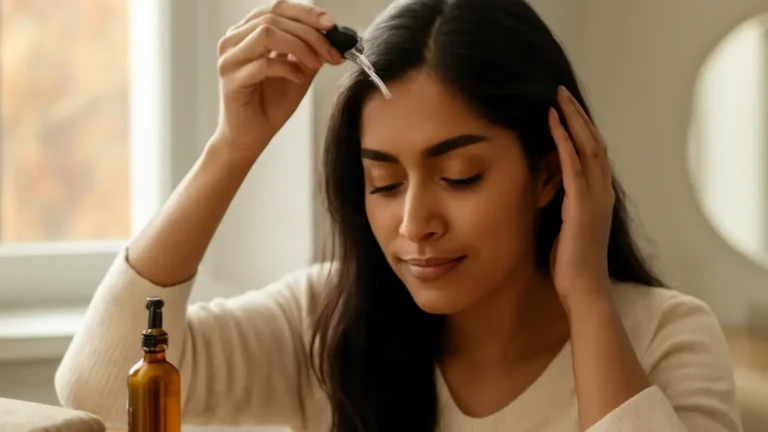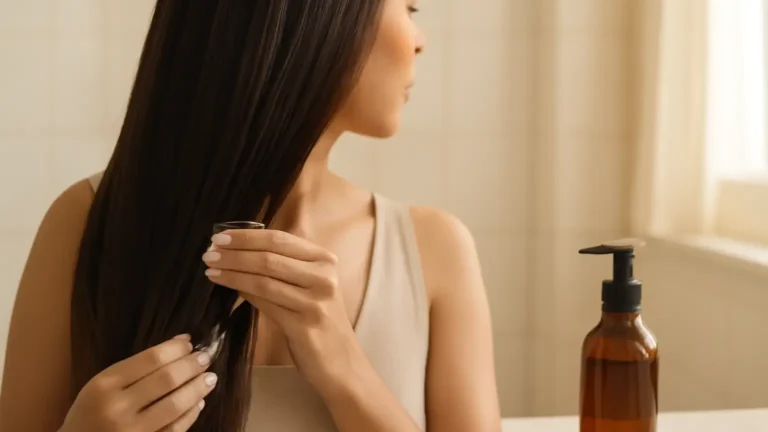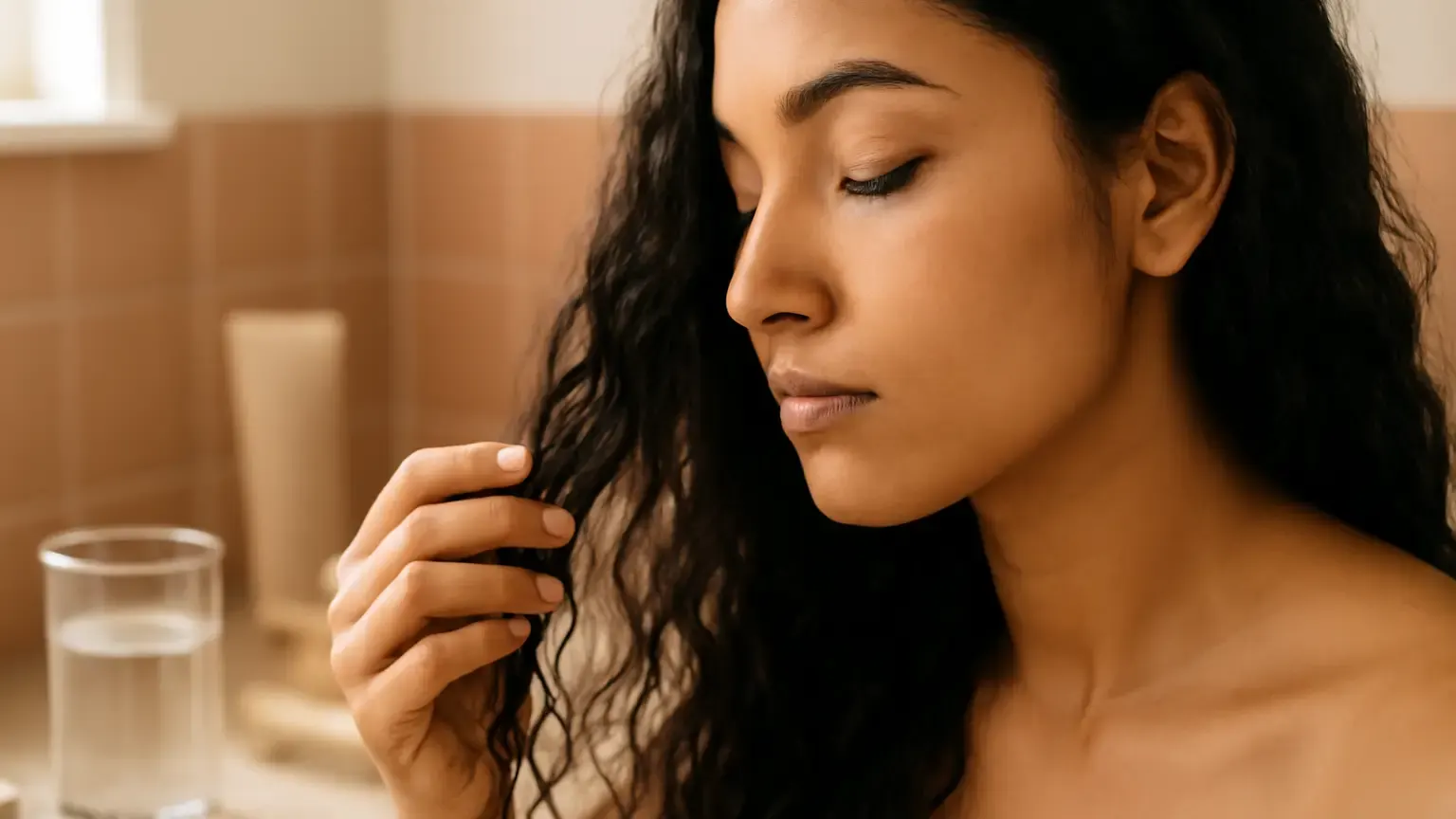
A hair porosity test can help you understand why your strands take hours to dry, reject conditioner or collect buildup quickly. This guide is for anyone choosing products for natural, wavy, curly or chemically treated hair, especially in India’s varied climate. Instead of relying on one viral float test, compare drying time, product absorption and buildup over several wash days. That pattern can guide product weight, moisture balance and styling choices more reliably.
Hair porosity describes how easily your hair’s cuticle layer allows water and cosmetic ingredients to enter and leave the hair shaft. It is not the same as curl pattern, thickness, density or damage level. Two people with straight hair can have different porosity, and curls in the same head can behave differently.
Porosity exists on a spectrum. Low porosity hair often resists water and product absorption, while high porosity hair may take in water quickly but lose moisture just as fast. Medium porosity hair tends to absorb and retain moisture more comfortably. These are useful working categories, not permanent diagnoses. Colouring, bleaching, heat styling, sun exposure, friction and hard water can change how sections of hair behave.
Why one hair porosity test is not enough
Many popular tests reduce a complicated hair response to one dramatic result. A strand may float because of surface tension, styling residue or trapped air rather than its porosity. A strand may sink after becoming saturated with water, but that does not automatically prove high porosity. Similarly, a spray test on dry hair can be affected by oils, silicones, humidity and how tightly the cuticle lies that day.
The most useful approach is observational: look for repeated patterns on clean, product-free hair over more than one wash day. Compare your roots with your ends, because older ends are usually more weathered. The aim is not to assign a perfect label. It is to decide whether your routine needs lighter layers, more conditioning, better sealing or less product overall.
Check 1: Observe hair drying time
Hair drying time is one of the most practical clues because it reflects both water retention and strand condition. After washing, gently squeeze out water with a soft T-shirt or towel. Do not compare a tightly packed bun with loose hair left open. Let it air-dry in the same room, without oil, leave-in conditioner or styling cream, and note when the roots and ends become dry.
- Possible low-porosity pattern: water sits on the surface during washing, and the hair takes a long time to become fully wet. It may also take a long time to dry because water struggles to enter and leave the cuticle.
- Possible high-porosity pattern: strands become wet quickly and may dry unusually fast, especially at the ends. Frizz, roughness or a dry feeling can return soon after washing.
- Possible medium-porosity pattern: hair wets and dries at a moderate, fairly predictable pace without needing excessive heat or repeated product layering.
Drying time is influenced by density, strand thickness, hair length, indoor humidity and the weather. In coastal cities, high humidity can slow evaporation; in dry or air-conditioned rooms, hair may dry faster. Therefore, use this check as a clue rather than a verdict. If your roots dry in an hour but your thick ends remain damp for much longer, assess those areas separately.
Check 2: Watch product absorption
Product absorption means how your hair responds when you apply water-based conditioner, leave-in conditioner or styling products. Start with freshly washed, soaking-wet hair. Use a small amount of one product, spread it between your palms and smooth it over a section. Watch what happens over the next few minutes.
Signs of slower absorption
When conditioner seems to sit on the surface, hair feels coated rather than softened, or a product makes strands limp quickly, you may have a low-porosity pattern. This does not mean your hair needs no moisture. It may respond better to warm water, smaller amounts and lightweight hair products such as a fluid leave-in, light conditioner or mousse.
Apply products in thin layers rather than adding a large amount at once. Gentle warmth from a shower cap can help a conditioner spread, but avoid excessive heat, especially on chemically treated hair. Check the ingredient list for a balance of humectants, conditioning agents and light emollients rather than choosing a product only because it is labelled for a particular porosity.
Signs of rapid absorption or moisture loss
If hair absorbs water and conditioner immediately but feels rough, puffy or dry again soon after styling, it may show a high-porosity pattern. Hair can also tangle easily, look frizzy and lose definition as it dries. For this pattern, a richer conditioner, cream or a small amount of oil over damp hair may help reduce moisture loss. Avoid treating heavier products as a cure; excessive layering can create dullness and hair product buildup.
Product absorption is also affected by damage. Bleached or frequently heat-styled areas may absorb formulas differently from untouched roots. This is why applying one product to the whole head can give confusing results. Try a small amount on a representative section and judge softness, slip, definition and next-day feel.
Check 3: Track buildup and wash-day behaviour
Buildup is the repeated accumulation of styling products, oils, dry shampoo, minerals or shed skin on the hair and scalp. It is not a definitive porosity test, but it can reveal whether your current product weight matches your strands.
A low-porosity pattern may show buildup quickly: hair looks dull, feels waxy or becomes greasy at the roots even when the ends still feel dry. Conditioner may seem to stop working, and curls or waves may lose volume. In that situation, reduce the amount of butter, oil and heavy cream. A periodic clarifying shampoo can remove product and mineral residue when needed, followed by a normal conditioner. Clarifying too often may leave hair feeling rough, so frequency should match your routine and water quality.
High-porosity or damaged hair may tolerate richer conditioning but still become rough after cleansing. It can benefit from a consistent deep conditioning routine and careful handling while wet. If strands feel unusually weak or stretchy, a protein-containing formula may be worth considering, but a protein treatment for hair should not be used automatically or excessively. Follow the product directions and stop if the hair becomes stiff or brittle.
Look at your hair 24 to 48 hours after washing, not only immediately after styling. Does it remain soft? Does it lose shape? Do the ends become dry while the scalp becomes oily? These delayed observations are often more useful than a glass of water test.
How to test hair porosity at home: a simple routine
- Begin with clean hair. Wash away oils and styling residue, but do not scrub aggressively or use a harsh cleanser solely for testing.
- Use consistent conditions. Repeat the observation on two or three wash days, preferably with similar water temperature and drying method.
- Record three details. Note how quickly hair becomes wet, how the product spreads and how long the hair takes to dry.
- Assess the following day. Check softness, frizz, volume, tangling and whether your hair feels coated.
- Compare sections. Roots, mid-lengths and ends may need different amounts of product.
This routine is a more useful answer to “how to test hair porosity at home” than a single pass-or-fail experiment. If results conflict, treat that as information. Your hair may have medium porosity at the roots and higher porosity at the ends, or its response may be changing because of damage and weather.
Choosing products from the overall pattern
| Repeated pattern | Try first | Use caution with |
|---|---|---|
| Products sit on hair, buildup appears quickly and volume disappears | Light conditioner, watery leave-in, mousse and smaller quantities | Heavy butters, multiple oils and frequent layering |
| Hair wets and dries moderately, with balanced softness | A simple conditioner and styling product matched to your texture | Changing the entire routine based on one test |
| Hair wets quickly, dries fast, frizzes and feels rough at the ends | Richer conditioning, a small sealing layer and gentle detangling | Over-cleansing, high heat and brushing dry hair aggressively |
Moisture balance is about the right combination of water, conditioning ingredients and protection, not maximum hydration at every step. A lightweight formula can be ideal for fine, low-porosity strands, while thicker or damaged ends may need more slip. If a product makes hair greasy, sticky or flat, use less before abandoning it entirely. If hair remains dry despite a careful routine, reassess cleansing, heat, friction, colour history and water quality.
Common mistakes with porosity checks
- Taking the float test literally: the water test is affected by residue, air and surface tension, so it cannot classify hair on its own.
- Testing coated hair: oils, silicone-rich serums and styling film can block water and distort the result.
- Confusing dryness with high porosity: dry-feeling hair may simply be over-cleansed, exposed to heat or lacking conditioning.
- Confusing oiliness with low porosity: scalp oil production and hair porosity are separate factors.
- Ignoring the ends: old, split or coloured ends often behave differently from new growth.
- Changing everything at once: introduce one adjustment at a time so you can identify what helped.
When to seek professional advice
Porosity guidance is suitable for routine product decisions, but it cannot explain every hair or scalp concern. Persistent itching, painful scalp areas, sudden shedding, pronounced breakage or ongoing changes that worry you deserve advice from a dermatologist or qualified healthcare professional. Avoid using a porosity label to self-diagnose a medical or scalp condition.
Takeaway
The best hair porosity test is not one viral trick. Compare drying time, product absorption and buildup on clean hair across several wash days, then choose product texture and styling steps from the repeated pattern. Start with small amounts, adjust moisture and cleansing gradually, and remember that different sections of the same head can need different care.
Products that may help with this routine
Choose products based on your skin, hair or personal needs rather than buying every item in a routine.
- Lightweight Leave-in Conditioner Amazon India
(paid link) See relevant options on Amazon - Clarifying Shampoo Amazon India
(paid link) See relevant options on Amazon - Deep Conditioning Hair Mask Amazon India
(paid link) See relevant options on Amazon - Hair Mousse For Curls Amazon India
(paid link) See relevant options on Amazon
Frequently Asked Questions
How do you test hair porosity at home?
Wash away styling residue, observe how quickly your hair becomes wet, note whether conditioner absorbs or sits on the surface, and track drying time and next-day buildup over two or three wash days. This combined observation is more reliable than one glass-of-water test.
Is the float test accurate for hair porosity?
The float test is not definitive. Surface tension, trapped air, oils, silicones and other residue can affect whether a strand floats or sinks. Use it only as a casual clue and compare it with drying time, product absorption and buildup.
How can I tell if my hair has low porosity?
A repeated pattern of water sitting on the hair, products feeling coated, slow absorption and quick buildup may suggest low porosity. Hair may also take a long time to become fully wet. Compare clean sections over several wash days before changing your routine.
What products are best for low-porosity hair?
Start with lightweight hair products, a light conditioner or fluid leave-in, and modest amounts of styling product. Warm water and gentle warmth during conditioning may help spreading. Avoid automatically choosing heavy oils and butters if they leave hair coated or limp.
How should I choose products for high-porosity hair?
If hair repeatedly wets quickly, dries fast, frizzes and feels rough, try richer conditioning, a careful leave-in layer and a small amount of sealing oil or cream. Reduce heat and friction, and adjust based on softness rather than relying only on a porosity label.
Does hair porosity affect drying time?
It can, but drying time is also affected by strand thickness, density, length, weather and humidity. Use drying time as one clue alongside product absorption and buildup, and compare the same hair section under similar conditions.