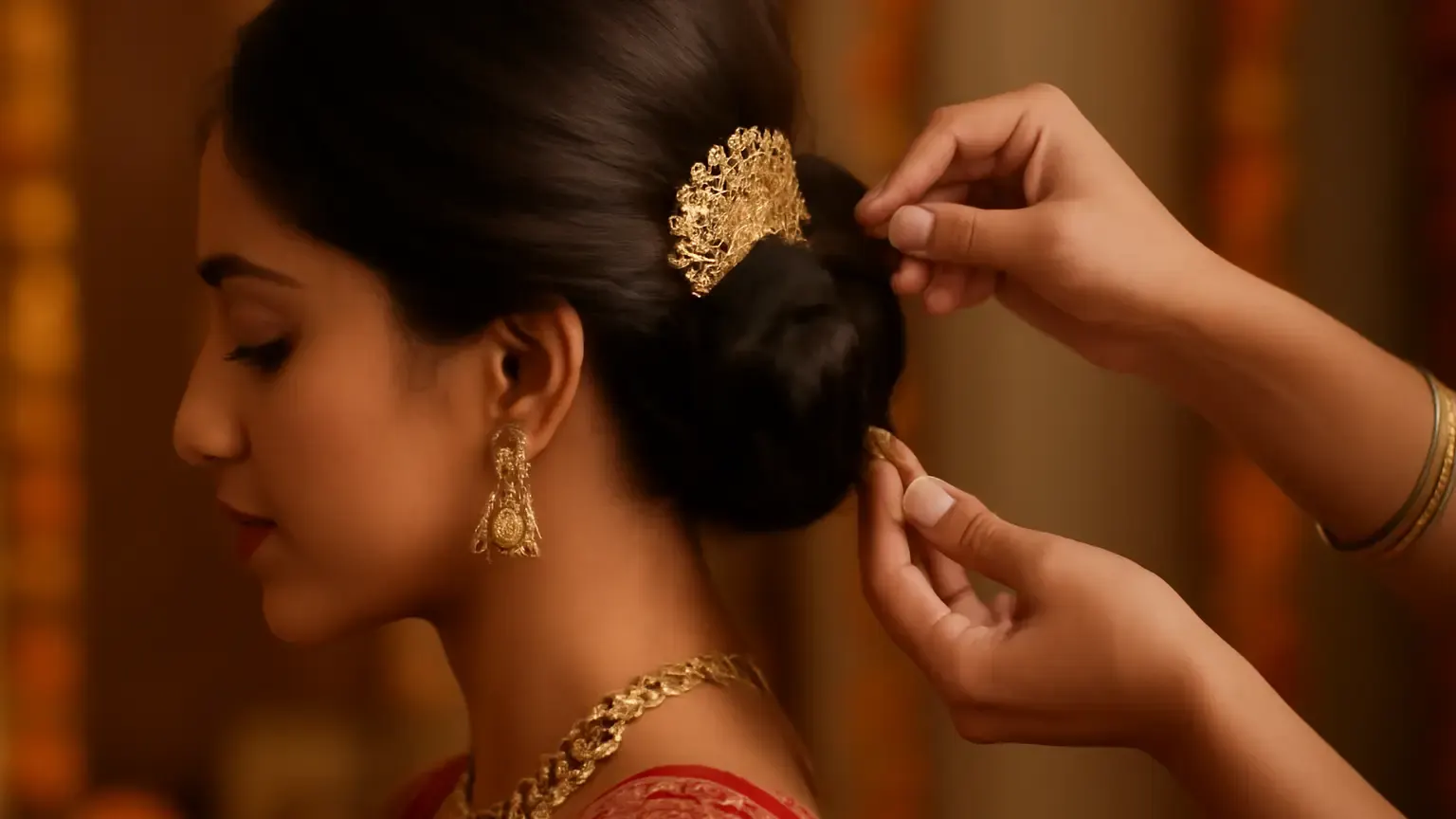
These hair care tips for festive accessories are for anyone wearing juda pins, gajras, hair chains or clips at weddings, pujas and festive gatherings. Place accessories into a stable section rather than loose lengths, cover rough edges, and remove each pin in the direction it entered. That simple combination helps reduce snags, tension and split ends without flattening the hairstyle or compromising its hold.
Festive hair accessories can make a simple braid, bun or open hairstyle look occasion-ready, but the wrong placement can turn a few hours of wear into painful tugging and difficult detangling. Bobby pins, U-pins, decorative combs, hair chains and gajras create friction when they catch the outer hair layer. Heavy pieces can also pull repeatedly on the same small section.
Why festive accessories snag or stress the hair
A hair accessory usually causes trouble for one of three reasons: a rough or bent edge catches the strand, the accessory is inserted against the direction of the hair, or too much weight is supported by a tiny section. Sweat, humidity and styling products can make strands cling together, while dry or already tangled hair is more likely to knot around metal.
Snagging is not the same as ordinary shedding. A strand may break at a weak point when it is pulled, or several strands may become trapped beneath a pin. Repeated traction around the hairline and temples can also make a style uncomfortable. The aim of hair care with clips and pins is not to avoid accessories altogether; it is to control friction, pressure and removal.
Prepare the hair before choosing an accessory
Start with hair that is clean enough to style but not slippery from excess oil or heavy serum. If the lengths feel dry, apply a small amount of leave-in conditioner or a light smoothing product from mid-length to ends. Avoid coating the roots heavily, because an overly slick base encourages pins to slide and makes you add more of them.
- Detangle first: Use your fingers on obvious knots, then work with a wide-tooth comb from the ends upwards.
- Choose a stable base: A braid, low bun or twisted section gives a pin more hair to grip than loose, fine strands.
- Separate the accessory weight: For a heavy brooch, comb or hair jewellery, use two or more secure anchor points instead of one tight pin.
- Check the hardware: Reject pins with chipped coatings, exposed sharp ends, loose beads or distorted legs.
These steps support hair snag prevention before the styling begins. If your hair is very fine, chemically treated, recently coloured or prone to snapping, choose lighter decorations and a softer hold rather than forcing a heavy design into place.
Hair care tips for festive accessories: place pins without trapping strands
Anchor the hairstyle, not the loose ends
Insert a pin into the bun, braid or twisted base whenever possible. Picking up a thin slice of loose hair at the surface may look neat, but it concentrates pressure on individual strands. For a bun, slide the pin along the bun’s edge, catch a little of the base, and angle it back into the style. This creates a supportive loop instead of a straight pull.
Use the right direction and spacing
Do not repeatedly push a pin in and out while searching for the perfect position. Open the section with your fingers, insert the pin with the wavy side facing the scalp when that design is intended to grip, and avoid scraping the scalp. Cross two pins only when necessary; crossing them can improve stability, but too many overlapping pins create a trapped cluster that is difficult to remove.
For safe hair accessory placement, keep pins away from the exact same hairline spot. Move the anchor a little along the bun or braid so pressure is distributed. A decorative comb should enter a compact, supported section rather than being forced through loose hair. If the piece rocks when you gently touch it, fix the base rather than tightening it aggressively.
Reduce pressure with hair-friendly festive styling
A comfortable style often lasts longer than a tightly pulled one. Protective hairstyles for Indian weddings can include a low braided bun, a relaxed side braid, a tucked ponytail or a twisted half-up style. These designs offer a broad base for flowers and jewellery while keeping the accessory away from fragile ends.
When selecting an accessory, consider:
- Weight: Larger metal pieces need a stronger base and more than one anchor point.
- Surface: Smooth, rounded, fabric-covered or coated parts are generally less likely to catch than rough wire or chipped metal.
- Length of wear: A style for a short puja can tolerate less reinforcement than one worn through a full wedding function.
- Hair density: Fine hair may need a smaller clip or a soft scrunchie; thick hair may need longer, well-finished pins that do not force the section too tightly.
If you are comparing the best pins for thick hair, prioritise adequate length, smooth tips and a secure but non-pinching shape. For fine hair, a smaller, lightweight pin may be safer than a long pin that slides through and catches the scalp or underlying strands.
Cushion sharp pressure points before wearing jewellery
Cushioning sharp hair accessory edges is useful when a decorative piece has a firm metal base or a narrow contact point. You can place a small piece of soft, clean fabric between the accessory and the hair, provided it does not make the piece unstable. A fabric-covered elastic or silk scrunchie can also form a gentler foundation for a ponytail or half-up section.
Do not use adhesive directly on hair, and do not wrap bulky material around a pin if it makes removal difficult. Check that the cushioning is not pressing into the scalp and that no thread or fibre can wind around the strands. A quick hand check before leaving home can identify a sharp corner or loose decoration that would otherwise catch later.
How to wear clips and pins without increasing tension
Clip the hair in a broad section rather than snapping a small amount into a large, tight clasp. Position the clip where the hair already has support, such as above a braid or near a twist. If a clip slides, improve the base with a small braid or a gentle texture product instead of repeatedly tightening the clip.
To reduce tension from hair accessories, make sure you can move your eyebrows, turn your head and lie back briefly without a sharp pulling sensation. Mild awareness of an accessory is normal; persistent pinching, scalp tenderness or a headache is a sign to loosen or reposition it. Do not sleep in rigid pins or heavy jewellery, even if the style still looks intact.
Remove every accessory slowly and in the reverse direction
Removal is where many avoidable breaks occur. Sit in good light and work with dry, patient hands. Support the hairstyle with one hand while you remove one accessory at a time. Do not pull a pin straight out if its legs are crossing or if hair is visibly wrapped around it.
- Take off flowers, chains and detachable decorations first so their weight is no longer pulling on the base.
- Hold the hair near the pin to reduce movement at the roots.
- Open a clip fully before sliding it out; do not drag a closed clasp through the hair.
- For a bobby pin or U-pin, retrace the path it took into the hairstyle and gently lift the hair away from its tip.
- If a strand is caught, pause and separate the surrounding hair with your fingers rather than jerking the accessory.
The safest answer to “how to remove bobby pins without pulling hair” is to release the grip first, support the section, and move the pin back along its entry route. If a pin is bent, stuck or tangled into a knot, do not force it. Ask someone to help in good light, and consider sacrificing the damaged accessory rather than pulling hard on the hair.
Post-event hair care after accessories
Once the pieces are out, gently shake the hair loose and inspect the areas where pins sat. Begin detangling hair after accessories with your fingers, especially around the bun, nape and hairline. Then use a wide-tooth comb from the ends upwards. If product, sweat or flower residue is present, wash according to your usual routine with a gentle shampoo and condition the lengths.
A short post-event hair care routine can be enough: remove all hardware, finger-detangle, comb in sections, cleanse when needed, and let the hair dry without tight tying. Avoid immediately putting the hair into another tight ponytail. If strands feel unusually fragile, handle them minimally and skip aggressive brushing while wet.
Common mistakes to avoid
- Using a damaged pin because it matches the outfit.
- Hiding a large accessory in loose hair without creating a stable base.
- Adding more pins whenever the first ones slide instead of correcting the hairstyle.
- Pulling an accessory through a knot or removing several pins as one cluster.
- Ignoring repeated scalp pain, strong tenderness or visible breakage around one area.
Persistent scalp discomfort, marked hair loss, sores or ongoing breakage deserves personalised advice from a dermatologist or other qualified healthcare professional. General styling care cannot identify the cause of concerning symptoms.
Quick takeaway
The most reliable way to follow hair care tips for festive accessories is to build a stable base, choose smooth and appropriately sized hardware, spread the weight, cushion rough contact points and remove each piece along its entry path. A relaxed, supported hairstyle is usually kinder to the hair than a tightly secured one, especially during long Indian wedding or festive events.
Products that may help with this routine
Choose only what fits your skin, hair or personal needs. Use the links below to view current options on Amazon India.
Frequently Asked Questions
How can I prevent hair snagging from festive hair accessories?
Detangle before styling, use smooth undamaged pins, anchor accessories into a braid or bun, spread heavy pieces across more than one point, and remove them slowly in the reverse direction.
How do I remove hair pins without pulling hair?
Support the hair near the pin, open or loosen its grip, and slide it back along the route it entered. Separate trapped strands with your fingers instead of tugging the pin through a knot.
Which hair accessories are safest for fragile hair?
Lightweight accessories with smooth, rounded or fabric-covered surfaces are generally a gentler choice. Select a secure base, avoid rough or chipped metal, and do not use a piece that pinches or repeatedly catches strands.
How do I detangle hair after wearing hair jewellery?
Remove jewellery first, then finger-detangle around the anchor points. Follow with a wide-tooth comb from the ends upwards, and wash and condition if sweat, styling product or flower residue remains.
What is the best hairstyle to wear with heavy festive accessories?
A low braid, braided bun or supported twist usually distributes weight better than loose hair. Use more than one anchor point and avoid making the base so tight that it causes pulling or discomfort.