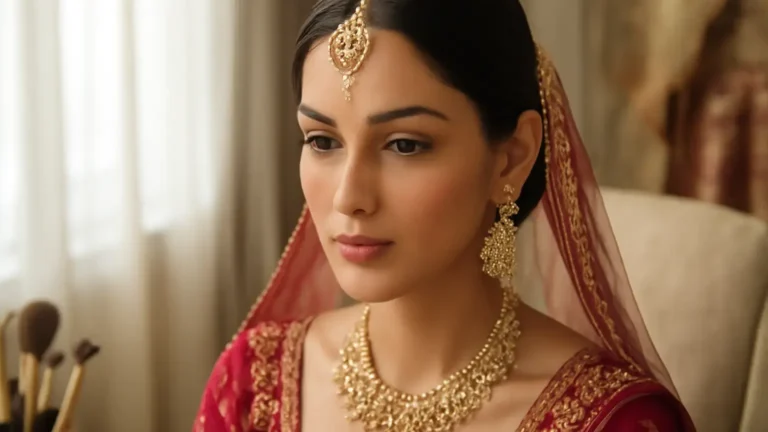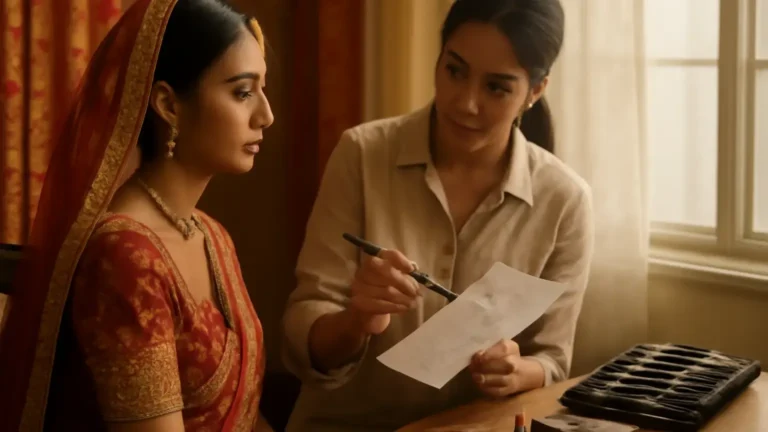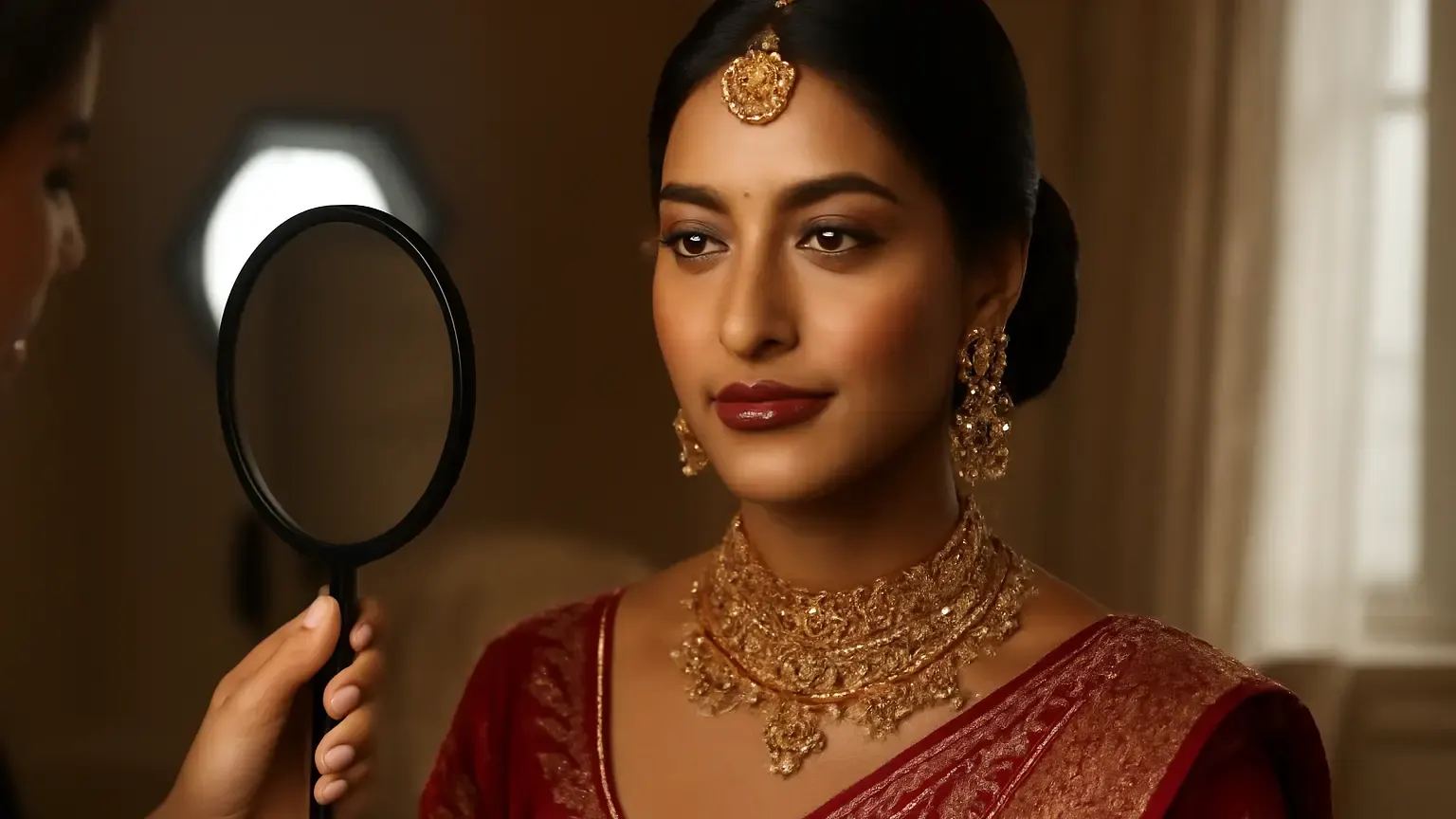
Bridal makeup for dusky skin looks most polished in flash photos when seven choices work together: the undertone match, foundation depth, concealer balance, base finish, blush family, lip colour and a real flash test. This guide is for Indian brides and makeup artists planning a wedding look for deeper complexions. It explains what to ask at the trial and how to check every shade in daylight as well as on camera, without making the skin look grey, flat or over-powdered.
Deeper complexions do not need to be made lighter to look bridal. The most flattering result usually comes from accurate colour matching, controlled radiance and enough contrast around the cheeks and lips to remain visible in photographs. A shade that looks beautiful under salon lighting can turn ashy in daylight or appear too pale under direct flash, so the trial should test more than the mirror.
Start with a simple trial-day method
Arrive with clean, moisturised skin and, if possible, wear the jewellery and neckline you expect to use. Take three photos before the makeup: one beside a window, one in indoor warm light and one with the phone flash. After the makeup is applied, repeat the same shots from the same distance. Wait 15 to 20 minutes before judging the base so you can notice settling or oxidation.
Ask the artist these questions:
- Which undertone do you see in my neck, chest and face?
- Will this foundation deepen or change colour after it sets?
- Can we test the base without a brightening filter?
- Which products contain brightening powders that may cause flashback?
- Will the blush and lip colour still show after powder, jewellery and flash?
- Can I see the look in natural light before we finalise it?
Use the jawline and upper neck for comparisons, not the hand. Your hand is often a different depth and undertone from your face.
1. Match the undertone before choosing the shade
Undertone is the subtle colour beneath the surface of the skin. It is usually warm, neutral or cool, although many Indian complexions have an olive or golden-neutral quality. Warm undertone makeup often works with golden, yellow or olive foundations; neutral undertone makeup should not look strongly pink or strongly yellow.
Check the face, neck and upper chest in indirect daylight. If a foundation looks orange against the neck, it is too warm. If it looks pink, grey or chalky, the undertone is probably wrong. Ask the artist to place two or three narrow stripes from jaw to neck, allow them to settle, and photograph the comparison. The best match should visually disappear across the jaw rather than make the face look brighter than the body.
2. Choose foundation depth, not a lighter bridal mask
A good dusky skin foundation match should blend into the neck and chest while giving enough coverage for an even photograph. Foundation depth and undertone are separate decisions: a deep golden shade can still be the wrong depth, and a correct depth can still look ashy if its undertone is off.
For bridal base makeup, use coverage where it is needed rather than applying a thick layer everywhere. A high coverage foundation can be useful for a long ceremony, but it should be applied in thin layers and pressed into the skin. Check the result after setting because some formulas oxidise slightly. Take a daylight photograph at arm’s length and a flash photograph from the expected portrait distance. The face should remain the same general depth as the neck in both.
Decision rule: choose the shade that matches the body, then adjust coverage with targeted concealer. Do not choose a pale foundation to create a “bridal” effect.
3. Balance concealer instead of over-brightening
Concealer should soften darkness and even the area around the eyes, not create two noticeably lighter patches. If under-eye darkness has a blue, purple or brown cast, a small amount of orange concealer may help neutralise it before foundation or concealer. On medium-deep to deep skin, use orange carefully; too much can make the area look warm and heavy.
Test concealer on one eye first. Compare it with the untreated side in window light, then use flash. The corrected side should look rested but still connected to the rest of the face. Ask: “Does this shade conceal, or is it only making the area lighter?” A concealer close to the skin depth is often best for blemishes, while an only slightly brighter shade can lift the under-eye. Avoid very pale beige products, which may look grey in photographs.
4. Select a base finish that keeps dimension
The right finish is a shade decision as well as a texture decision because reflective and brightening particles affect how the complexion photographs. A satin or soft-matte base generally preserves shape without making the face look flat. Very dewy products can reflect flash unevenly, while heavy powder can remove the natural depth and dimension of deeper skin.
Ask for a controlled glow on the high points rather than shimmer across the whole face. Look at the forehead, nose, cheeks and chin in daylight. Then take a direct-flash photo. A flashback-free makeup result should not show a white veil or pale patches, especially under the eyes and along the centre of the face. Flashback is often linked to excessive brightening powders or certain high-SPF and silica-heavy formulas, so product testing matters more than a label alone.
5. Choose a blush family with enough warmth and contrast
Blush can disappear on deeper complexions when the colour is too pale, too cool or heavily muted by powder. Terracotta blush, burnt peach, cinnamon, warm rose and rich coral usually create visible warmth without looking harsh. A cream blush can give a seamless first layer, followed by a coordinating powder blush if extra longevity is needed.
Place blush slightly higher on the cheek and blend towards the temple, keeping the strongest colour on the cheek rather than directly beside the nose. Check it in natural light for patchiness and in flash for visibility. The shade should be noticeable in a portrait but not look like a separate stripe. Ask: “Does this blush still show after foundation and translucent powder?” If not, choose greater depth or saturation rather than applying an unnecessarily thick layer.
6. Pick a lip colour family that supports the bridal palette
Lip colour should relate to the lehenga, jewellery, eye makeup and blush, but it does not need to match them exactly. For red or maroon bridal outfits, brick red, wine, deep rose and warm berry lipstick can provide definition. For pink, peach or gold outfits, rose-brown, caramel nude, terracotta and cinnamon tones often offer balance. A berry lipstick is especially useful when the eyes are softly defined and the bride wants a richer focal point.
Test the lip shade with the full base, not on bare skin. Foundation can change how a colour appears, and flash may reduce the apparent warmth of some nudes. Photograph the lips smiling and speaking in daylight and with flash. A nude should not turn grey or erase the natural shape of the mouth; a red should not become neon or overly purple. Use a lip liner close to the chosen colour to define the edges and reduce feathering, then blot before the final photograph.
7. Make flash-photo testing part of the shade decision
Flash-photo testing is the final check, not an optional extra. Ask the artist to photograph you from the front, three-quarter angle and side, because a base can look even straight-on but show a pale jaw or bright under-eye at an angle. Keep the camera at a realistic portrait distance and avoid filters, beauty mode and automatic skin smoothing.
What to check in the photos
- Face and neck: They should look like one connected colour family.
- Under-eyes: They should look smooth and rested, not white or orange.
- Texture: Shine should be controlled without a thick, dry powder layer.
- Blush and lips: Both should remain visible without dominating the face.
- Edges: Check the hairline, jaw, ears and neck for unblended product.
Also ask how the look will be maintained. A light setting spray can help powders and creams settle together, but it cannot correct a wrong shade. The artist should explain where to blot, how to press away oil without rubbing, and whether a small touch-up kit is needed.
Common mistakes to avoid on the wedding trial
- Choosing foundation by matching the hand or wrist.
- Using a very light concealer across the entire under-eye and centre face.
- Testing only under yellow salon bulbs.
- Applying white or pale shimmer where flash will hit directly.
- Picking a blush that looks bright in the pan but disappears on skin.
- Finalising the look before the base has settled and been photographed.
- Changing every product at once after a single unflattering photo.
If a photo looks wrong, isolate the cause: undertone, depth, powder, flash angle or colour intensity. Small, targeted adjustments are more reliable than adding more makeup.
Concise takeaway
The strongest bridal makeup for dusky skin starts with a neck-and-chest match, then builds balanced concealer, a dimensional base, visible blush and a lip colour suited to the outfit. Judge every choice in window light and direct flash, and leave the trial with comparison photos and a clear touch-up plan.
Products that may help with this routine
Choose products based on your skin, hair or personal needs rather than buying every item in a routine.
- Amazon India Bridal Makeup Setting Spray
(paid link) See relevant options on Amazon - Amazon India Terracotta Cream Blush For Dusky Skin
(paid link) See relevant options on Amazon - Amazon India Transfer Resistant Berry Lipstick
(paid link) See relevant options on Amazon - Amazon India Makeup Trial Mirror With LED Light
(paid link) See relevant options on Amazon
Frequently Asked Questions
What is the best foundation shade for dusky bridal makeup?
The best shade matches the undertone and depth of the bride’s neck and upper chest after the formula settles. Test jaw-to-neck stripes in natural light, then confirm the match with flash photography instead of choosing a lighter shade for a bridal effect.
How do you choose blush for dusky skin bridal makeup?
Look for shades with enough warmth and saturation, such as terracotta, burnt peach, cinnamon, rich coral or warm rose. Test the blush after foundation and powder; it should remain visible in daylight and flash without looking like a stripe.
Which lipstick suits dusky skin for a wedding?
Brick red, wine, deep rose, warm berry, terracotta and rose-brown can all work well. Choose according to the outfit and eye makeup, then photograph the shade with the complete base because pale nudes may turn grey under flash.
How can you prevent flashback in Indian bridal makeup?
Test the complete base with direct flash and avoid relying on brightening products that leave a white cast. Use setting powder sparingly, check the under-eyes and centre of the face from several angles, and confirm the result without camera filters.
What should be included in a bridal makeup trial checklist for dusky skin?
Include undertone and neck matching, foundation settling time, concealer balance, base finish, blush and lip visibility, natural-light photos, flash photos, jewellery or outfit coordination, and a touch-up plan for the ceremony and reception.