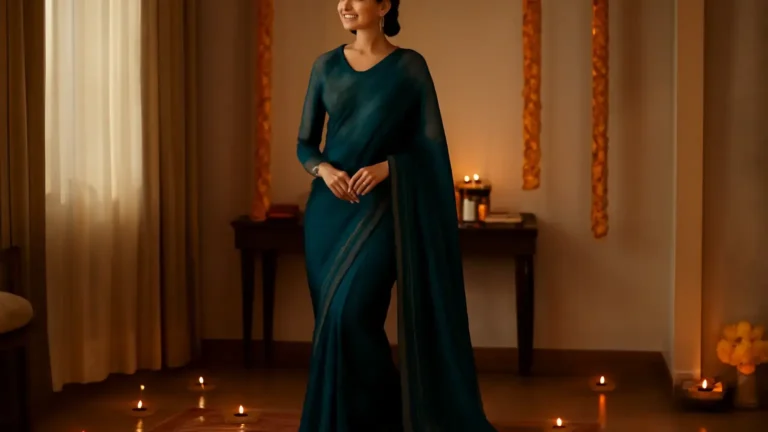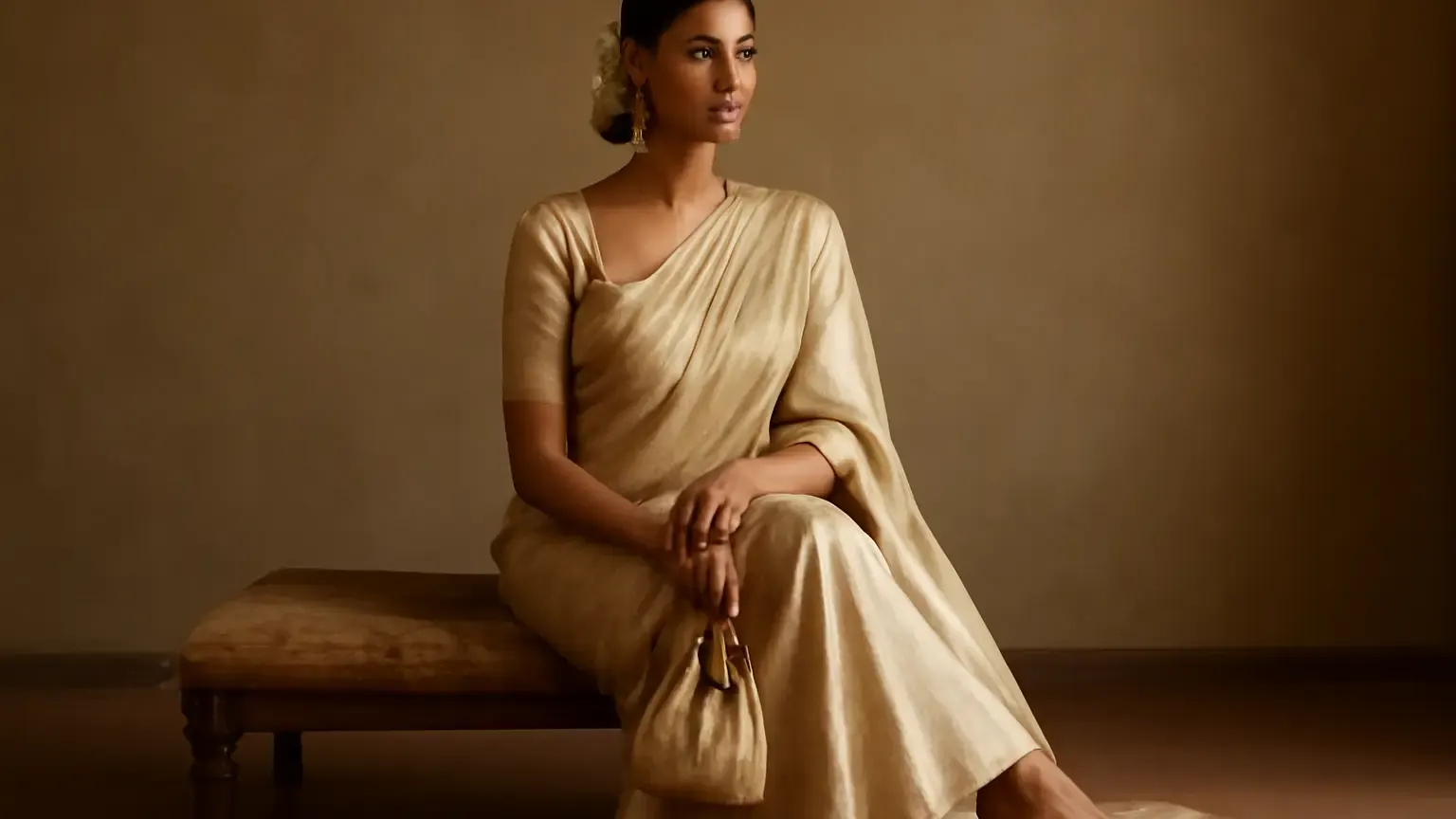
Saree accessories for women look most polished when every piece has a job: let one detail lead, then support it with coordinated jewellery, practical footwear, a suitable bag and a controlled drape. This guide is for anyone styling a saree for a wedding, festive gathering, office event or dinner, especially if the finished outfit often feels either too plain or too busy. Use the seven balancing principles below to decide what to add, what to simplify and what to leave out.
A saree can carry colour, texture, shine and pattern before you add a single accessory. The aim is not to decorate every visible space; it is to create a clear visual hierarchy. A heavily embroidered saree may need only refined jewellery, while a plain silk or chiffon saree can support a more noticeable necklace, earrings or bag.
The easiest way to answer how to style accessories with a saree is to assess the outfit in three layers: the saree and blouse, the face and upper body, and the finishing details such as footwear and handbag. These seven principles help those layers work together.
1. Choose one focal point before adding anything else
Start by deciding what you want people to notice first. It might be an ornate border, a dramatic blouse neckline, a pair of statement earrings, a traditional necklace or a richly decorated pallu. Everything else should support that choice rather than compete with it.
For example, a mirror-work blouse and a wide zari border already create visual interest. Pair them with smaller earrings, a slim bangle stack and a quiet bag. If the saree is a single colour with a simple blouse, statement earrings or a sculptural necklace can become the focal point.
This principle is especially useful for a minimal saree look. Minimal does not mean removing every accessory; it means giving one or two elements enough space to be noticed. A useful test is to stand several steps away from a mirror. If your eye jumps between the blouse, necklace, bangles, bag and hair ornament, edit one category.
2. Coordinate jewellery with the blouse and saree
Jewellery should respond to the blouse neckline, the saree’s finish and the formality of the occasion. This is more reliable than matching every item to the saree colour.
Use the neckline as your starting point
- A deep or wide neckline can accommodate a short necklace, collar-style piece or layered chain, provided the blouse surface is not heavily embellished.
- A high-neck blouse often looks cleaner with earrings, bangles or a ring instead of a necklace.
- A boat neck works well with medium-length necklaces or earrings that add vertical length.
- A detailed blouse front usually benefits from one strong jewellery category rather than several layered pieces.
For a useful answer to what accessories to wear with saree, consider contrast as well as coordination. Antique gold can enrich handloom cotton, silk and earthy colours. Polished gold suits traditional festive dressing, while silver or oxidised metal can complement cool colours and contemporary textiles. Pearls soften formal looks, but too many pearl details may appear overly matched.
These saree jewellery styling ideas also account for scale. Small facial features and delicate blouse details may be overwhelmed by very large earrings. Conversely, a broad border and dramatic makeup can carry a stronger jhumka or chandelier-style design. Choose one metal family when the saree is already visually rich; mixed metals work better when the outfit is intentionally modern and restrained.
3. Match the bag and footwear thoughtfully
A bag and shoes do not need to be identical, but they should belong to the same style story. A beaded potli with embellished sandals feels festive. A structured clutch with sleek heels feels more formal. A woven bag and flat sandals can suit a daytime or destination setting.
When choosing a saree handbag, check three practical points: whether it holds essentials without looking bulky, whether its strap will disturb the pallu and whether its surface catches on the fabric. A compact clutch or potli is often easier with a delicate saree, while a small shoulder bag may be more useful for a long event. Avoid placing a heavy crossbody strap over an elaborate pallu unless the saree is securely pinned.
For saree footwear, prioritise stability and the final hem length. Try the saree with the footwear before fixing the pleats; changing shoes afterwards can make the front look too long or too short. Block heels, low wedges and embellished flats are practical options when you expect to stand or walk. Choose a colour that repeats a subtle saree detail, matches the blouse, or provides a deliberate neutral base.
4. Use a waist belt selectively
A waist belt with saree can define the waist and keep the pallu in place, but it is not automatically flattering or necessary. It works particularly well with a clean drape, a tucked-in pallu and a saree made from a fabric that does not bunch easily. Slim metallic belts suit contemporary festive looks, while fabric or embroidered belts can blend with traditional styling.
Skip the belt when the saree has a very heavy border at the waist, a large amount of pleating, a stiff sculptural fabric or an already elaborate waist ornament. A belt can also interrupt a soft, fluid drape. If you want the practical hold without a strong horizontal line, use discreet pins or a narrow belt close to the saree colour.
Before leaving home, sit down and walk a few steps. The belt should feel secure without digging into the body, and the pallu should not pull diagonally across the blouse. Comfort is part of balance: an accessory that needs constant adjustment will make the whole look appear unsettled.
5. Keep hair accessories proportionate
Hair accessories for saree styling should relate to both the jewellery and the hairstyle. A sleek bun can support gajra, a small hairpin or a traditional veni. Loose waves may need only a discreet clip, while a simple braid can carry a narrow ribbon, flowers or a decorative braid ornament.
Think about visual weight. Large earrings, a necklace and an oversized hairpiece can crowd the face and neck. If the earrings are the focal point, keep the hair detail small. If the saree is simple and the jewellery is restrained, a neat flower arrangement can provide a beautiful traditional accent.
Secure flowers and pins so they do not snag the pallu. For outdoor events, choose lightweight details that will stay in place in humidity or movement. Hair accessories should frame the face, not create a separate competing focal point above it.
6. Refine the drape before adding more jewellery
Many styling problems are actually draping problems. Straight pleats, a balanced pallu and a correctly placed waistline can make a modest accessory selection look more polished than an overloaded outfit with a loose drape.
Useful saree draping tips include setting the footwear height first, keeping the pleats even, checking that the pallu falls at a comfortable length and pinning only where the fabric needs support. The pallu should show the saree’s border without hiding the blouse completely or dragging near the floor. If the saree is slippery, use hidden pins and avoid excessive layering underneath, which can add bulk.
Fabric affects the best approach. Crisp cotton and organza hold pleats and may need a neat, structured finish. Silk offers body and traditional presence. Chiffon and other fluid fabrics benefit from lighter pinning and a softer fall. A drape that suits the textile will reduce the need for extra accessories to make the outfit feel finished.
7. Edit the final look so no element competes
The last step is an intentional edit, not a last-minute addition. Take a full-length photograph in natural or bright indoor light and inspect the outfit from top to bottom. Ask these questions:
- What is the first detail I notice?
- Is the jewellery visible against the blouse, or is it being hidden by the neckline and pallu?
- Do the bag and footwear suit the event and allow comfortable movement?
- Are the hair details proportionate to the earrings?
- Is there one item I can remove without losing the outfit’s character?
This final check is where occasion-based saree styling becomes useful. For an office event, remove noisy bangles and choose a compact bag. For a wedding, you may add a richer earring or a traditional bangle stack, but keep the blouse, necklace and hairpiece from all becoming statement elements. For a daytime celebration, lighter jewellery and breathable footwear usually look more natural than heavy evening accessories.
A simple decision routine for a balanced saree look
Use this five-minute routine before dressing fully:
- Lay out the saree, blouse, jewellery, bag, footwear and hair accessories together.
- Identify the strongest visual detail and remove any item that challenges it.
- Check metal, colour and texture coordination without demanding an identical match.
- Put on the footwear, set the drape and test sitting, walking and reaching for your bag.
- Take one full-length photograph, then make one final subtraction rather than adding another piece.
The most common mistake is treating accessories as separate purchases instead of one composition. A beautiful necklace may not work with a high neckline; a fashionable belt may flatten an ornate border; a large bag may hide the pallu. Choose based on the complete outfit and the demands of the occasion.
Takeaway: build balance, not decoration
The best saree accessories for women are not necessarily the most elaborate ones. Choose a focal point, coordinate jewellery with the blouse, make the bag and footwear practical, use belts and hair ornaments with restraint, and perfect the drape before judging the finished look. When every detail supports the saree rather than competing with it, the result feels intentional, comfortable and easy to carry.
Products that may help with this routine
Choose only what fits your skin, hair or personal needs. Use the links below to view current options on Amazon India.
Frequently Asked Questions
How do you style accessories with a saree?
Choose one focal point first, then coordinate jewellery with the blouse neckline and saree texture. Add practical footwear, a proportionate bag and restrained hair details, and finish by checking the drape and removing one competing item.
What accessories should you wear with a saree for a wedding?
For a wedding, consider one stronger jewellery piece such as jhumkas, a necklace or bangles, then keep the remaining accessories coordinated and lighter. A potli, stable embellished footwear and a secure pallu complete the look.
What is the best jewellery for a saree blouse?
The best jewellery depends on the blouse neckline and embellishment. A high neck often suits statement earrings, while a simpler deep or boat neckline can support a necklace. Avoid covering a heavily embroidered blouse with too many layers.
Can you wear a belt with a saree?
Yes, a belt can define the waist and secure the pallu when the saree has a clean drape and manageable texture. Use a slim or coordinated belt, and skip it if it bunches the fabric or competes with a heavy border.
How do you choose a saree handbag?
Choose a compact bag that holds essentials, does not snag the fabric and will not disturb the pallu. Match its formality to the occasion: a potli or embellished clutch suits festive dressing, while a small structured bag can work for formal daytime events.