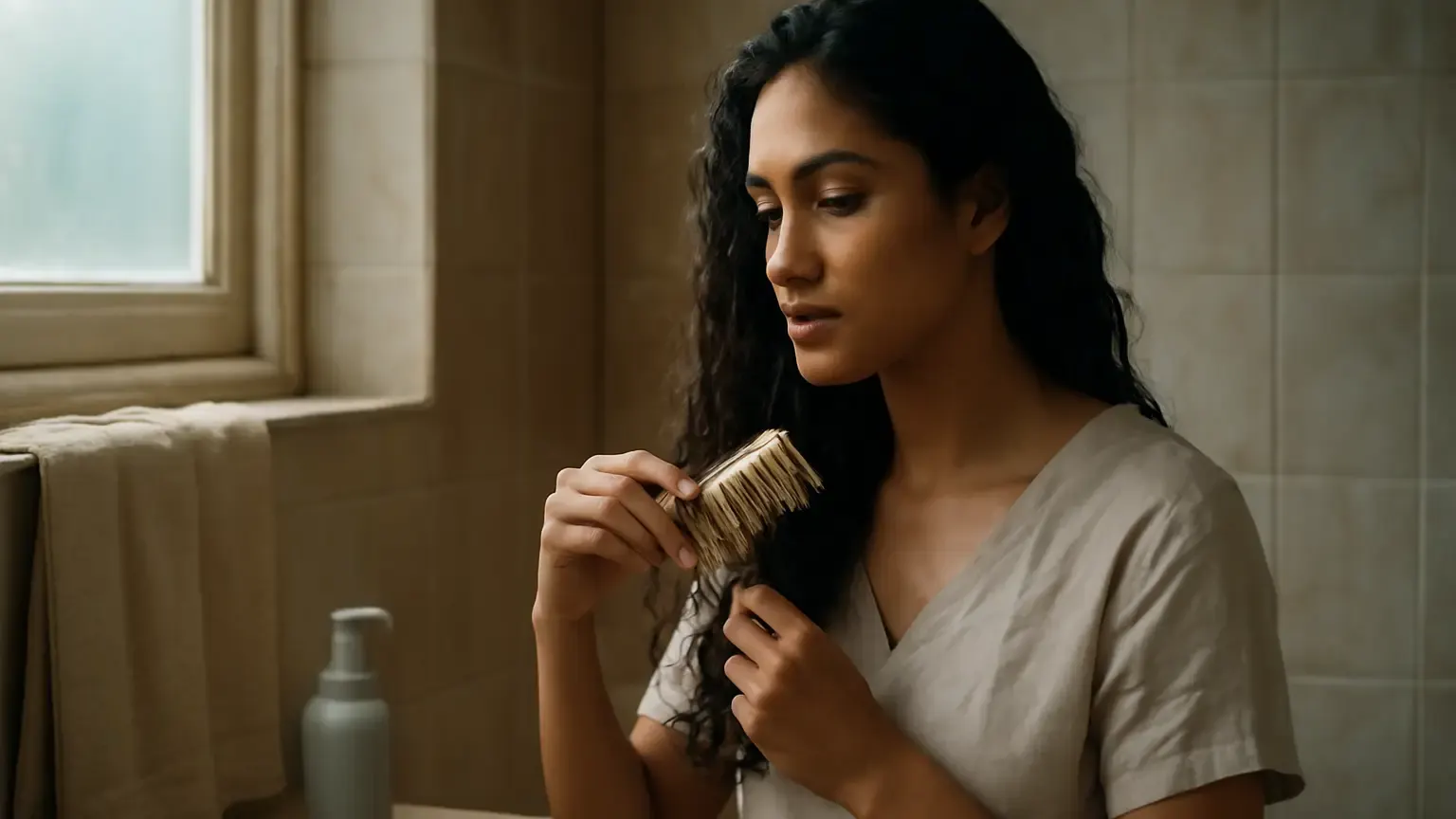
Hair care for Indian hair works best when it follows your strands—not a single traditional or viral routine. This guide is for people with straight, wavy, curly or coily hair living with concerns such as oily scalps, dense lengths, monsoon humidity or hard water. The key decision is simple: cleanse according to your scalp, condition according to your lengths, and adjust detangling and styling to porosity, density and daily exposure.
Why Indian hair needs a personalised routine
“Indian hair” describes a broad range of textures rather than one uniform type. Hair may be fine or coarse, straight or tightly coiled, low- or high-porosity, sparse or very dense. Even two people from the same region can need completely different routines.
Climate and lifestyle add another layer. Humidity can make wavy and curly hair expand and frizz, while heat and dry indoor air can leave lengths rough. Sweat, pollution, frequent oiling and mineral-rich tap water may affect how clean or soft the hair feels. A useful routine therefore separates four jobs:
- Cleanse the scalp: remove sweat, oil, dust and product residue without repeatedly stripping the lengths.
- Condition the lengths: add slip and reduce friction where hair is most vulnerable.
- Detangle gently: work from the ends upwards, especially when hair is thick or curly.
- Style for the environment: protect against humidity, heat, friction and moisture loss.
Your starting point should be behaviour, not a product label. Notice whether your scalp becomes oily within a day, whether water takes time to absorb, whether your ends stay dry after conditioning and whether your hair reacts badly to heavy oils or rich creams.
Match cleansing to scalp oiliness and water quality
Wash frequency should reflect scalp oiliness, sweat and styling buildup. An oily scalp may feel comfortable with washing every one to two days, while a dry or curly scalp may prefer a longer interval if it remains fresh and comfortable. There is no universal rule that every Indian hair type should be washed once or twice a week.
Choose the cleanser by the problem
A gentle cleanser can suit regular washing, particularly when the scalp is comfortable and the hair is dry at the ends. A sulphate-free shampoo may feel less drying for textured or chemically treated hair, but “sulphate-free” does not automatically mean ideal for everyone. Fine, oily hair can still need an effective wash, while very rich formulas may leave it flat.
If hair feels coated, limp or unusually rough after washing, hard water buildup or styling residue may be involved. Mineral-rich water can leave deposits on the hair and make conditioner seem less effective. Use a clarifying shampoo occasionally when buildup is the likely issue, following with conditioner. Do not use a strong clarifier daily, and do not confuse buildup with a medical scalp concern.
Use oil thoughtfully before washing
Pre-shampoo oiling can make some dry, coarse lengths feel more flexible before cleansing. Apply a small amount mainly to the mid-lengths and ends, leave it for a modest period, then shampoo thoroughly. It is not essential, and a very oily scalp, fine hair or acne-prone hairline may not enjoy it. Avoid aggressive massage or tight rubbing, which can increase tangling and breakage.
Read texture, density and hair porosity
Texture describes the shape of the strand—straight, wavy, curly or coily. Density describes how many strands grow on the scalp, while strand thickness describes whether each strand is fine, medium or coarse. These are separate traits: fine, dense curls need a different approach from coarse, low-density straight hair.
Low-porosity hair
Low-porosity hair can resist water and product absorption, so heavy layers may sit on the surface. Choose lighter conditioners, apply them to very wet hair and rinse thoroughly. Occasional gentle warmth from a shower can help conditioner spread, but high heat is unnecessary. Avoid using the popular float test as a definitive diagnosis; porosity is better judged by how your hair behaves over time.
High-porosity hair
With high hair porosity, moisture may enter quickly but leave quickly too. Hair often benefits from consistent conditioning, a leave-in product and a lightweight sealing layer on the ends. Chemical processing, repeated heat and physical wear can increase porosity, so reducing friction may matter as much as adding products.
Fine, thick and textured strands
Fine hair is easily weighed down by heavy oils, buttery masks and multiple styling layers. Dense or coarse hair may need more sections, more conditioner and extra time for complete saturation. Wavy, curly and coily hair usually benefits from keeping its natural clumps intact rather than brushing it dry. Straight hair may tolerate more frequent brushing, but rough tools and force can still cause breakage.
Build the conditioning and detangling routine
After cleansing, apply conditioner from the mid-lengths to the ends. Keep the scalp area light unless the product is specifically designed for it. Let the conditioner sit briefly, then detangle while the hair has slip. This is usually safer than pulling through dry knots.
A wide-tooth comb is useful for thick, wavy, curly or coily hair. Start at the tips, loosen small sections and move upward. For very textured hair, finger detangling first can reduce snagging. Divide dense hair into four or more sections rather than trying to force one large mass through a comb.
Deep conditioning can be helpful when lengths feel dry, rough or difficult to manage. Use it periodically rather than automatically at every wash. A light conditioner may be enough for fine hair. If hair feels weak, overly stretchy or damaged from chemical services, a protein treatment may be considered occasionally; if it makes the hair stiff or brittle-feeling, stop using it and return to a simpler moisture-focused routine.
Dry without adding avoidable friction
Do not twist wet hair tightly into a heavy towel. Gently squeeze out water and use a microfiber towel or a soft cotton T-shirt. Let textured hair dry in its natural shape, or use a diffuser on a low, comfortable setting. Sleeping on a smooth pillowcase and keeping long hair in a loose braid can also reduce overnight rubbing.
Adjust styling for humidity, heat and hard water
Humidity enters the decision-making process because porous hair can absorb moisture from the air, swelling the strand and disturbing a smooth finish. For frizz control, apply styling products to soaking-wet or very damp hair, avoid repeatedly touching it as it dries, and choose a hold level that matches the weather. Lightweight gel can support waves and curls; a small amount of serum may help smooth straight lengths.
When using a blow-dryer, straightener or curling tool, apply a heat protectant, keep the temperature moderate and avoid repeated passes over the same section. Heat protectant reduces exposure risk but does not make high heat harmless. Air-drying is not automatically better if hair remains wet for a long time and is handled roughly; gentle handling is the priority.
For an Indian hair care routine in a hard-water home, consider a shower filter or a properly selected mineral-removing product if buildup is persistent. These options have different capabilities, so check the product instructions rather than assuming every filter removes all minerals. If the scalp is irritated, intensely itchy, painful or shedding noticeably, seek advice from a dermatologist instead of repeatedly changing shampoos.
A practical weekly routine by hair behaviour
| Hair behaviour | Routine emphasis | What to limit |
|---|---|---|
| Oily scalp, fine lengths | Regular scalp cleansing, light conditioner on ends, minimal styling layers | Heavy oils at the roots and frequent rich masks |
| Dry, coarse or dense lengths | Sectioned washing, generous conditioner, occasional pre-shampoo oiling and low-friction drying | Rough towel drying and forceful detangling |
| Wavy or curly hair | Gentle cleansing, wet detangling, leave-in or gel, hands-off drying | Dry brushing and repeated touching during drying |
| High-porosity or processed hair | Regular conditioning, heat protection, careful trimming and occasional targeted treatments | Frequent hot tools and overlapping chemical services |
| Hair affected by hard water | Periodic buildup removal followed by conditioning | Daily harsh clarifying and excessive product layering |
Change one variable at a time and observe for two to three wash cycles. If hair becomes greasy, reduce the weight or improve cleansing. If it becomes rough, shorten clarifying frequency and increase conditioning. If curls lose definition, check for over-layering, dry brushing or residue before buying another product.
Common mistakes to avoid
- Using oil as a substitute for conditioner: oil can reduce friction, but it does not provide the same water-based conditioning and slip.
- Scrubbing the lengths: shampoo should primarily clean the scalp; letting the lather run through the lengths is often sufficient.
- Detangling from the roots: this pushes knots together and increases pulling at the scalp and mid-lengths.
- Assuming more product means more moisture: buildup can make hair dull, stiff or limp rather than hydrated.
- Following a fixed wash rule: climate, exercise, scalp oiliness and styling habits change the right schedule.
Takeaway: let your strands set the routine
The most useful hair care tips for Indian hair are adaptable: cleanse the scalp as often as it needs, condition the lengths according to texture and porosity, detangle with slip, and protect hair from humidity, heat, minerals and friction. Your best hair care for Indian hair routine may change between summer, monsoon and winter. Keep the structure simple, track how your hair responds, and adjust one decision at a time.
Products that may help with this routine
Choose only what fits your skin, hair or personal needs. Use the links below to view current options on Amazon India.
Frequently Asked Questions
How often should you wash Indian hair?
Wash according to scalp oiliness, sweat, pollution and styling buildup. Oily scalps may need washing every one to two days, while dry, curly or coily hair may need less frequent cleansing if the scalp remains comfortable and clean.
How can I care for Indian hair in humid weather?
Use conditioner or a leave-in product suited to your texture, apply styling products to damp hair, avoid dry brushing and reduce touching while hair dries. A suitable gel or serum can support frizz control without requiring heavy layering.
What are the best hair care tips for Indian hair in hard water?
Watch for dullness, roughness or conditioner that no longer gives slip. Use a clarifying or mineral-removing wash occasionally as directed, follow with conditioner, and consider a suitable shower filter. Avoid harsh daily clarifying.
Is pre-shampoo oiling good for Indian hair?
It can help some dry, coarse or high-porosity lengths feel more flexible before washing, but it is optional. Use a small amount on the lengths, avoid aggressive massage and reduce or skip it if your scalp becomes greasy or uncomfortable.
How do I detangle thick Indian hair without breakage?
Work in sections on wet or damp, well-conditioned hair. Use your fingers or a wide-tooth comb, start at the ends and move upward slowly. Do not pull a comb through a large dry knot or brush textured hair aggressively.